Apple Turns 50: 50 Ways It Could Use AI in Ways Only Apple Can
From the Neural Engine in 2.5 billion devices to the deepest health sensor stack in consumer tech — here is what a company with Apple's ecosystem, supply chain, and brand could actually do with AI.
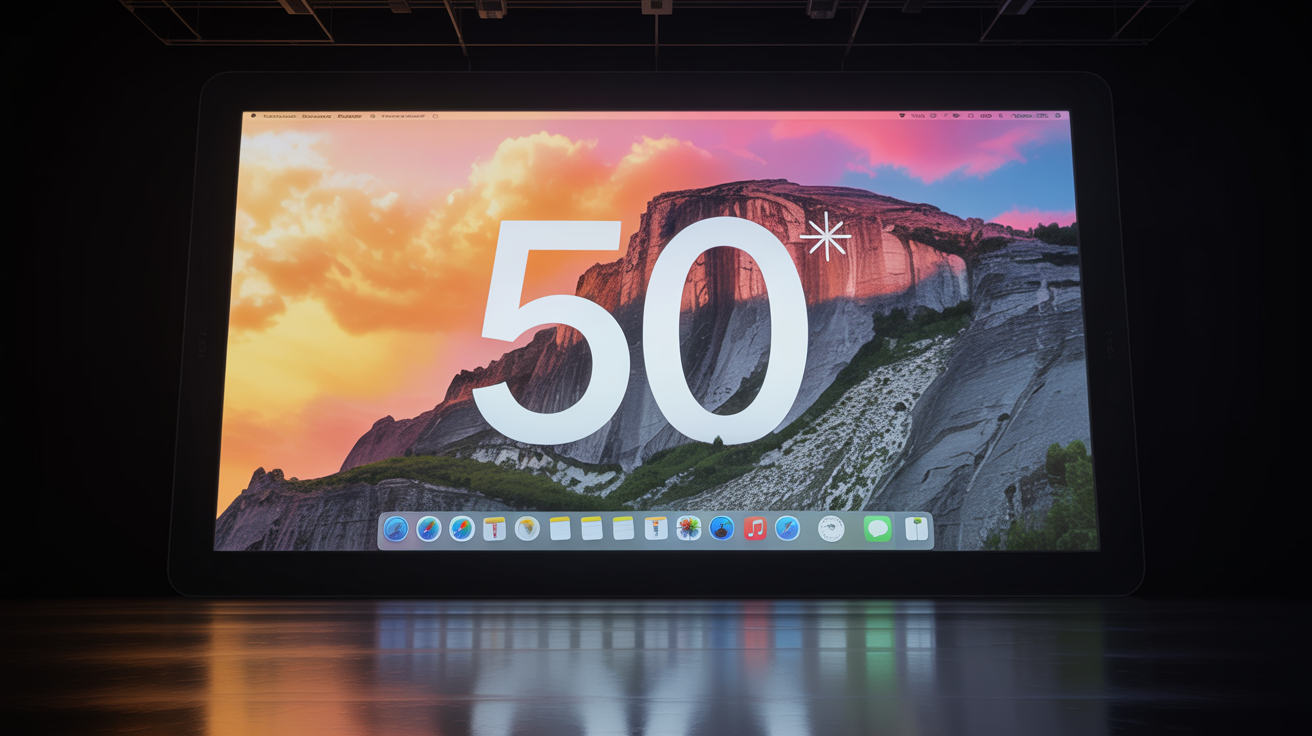
- ● Apple has 2.5 billion active devices, each running a dedicated Neural Engine. No other company has an on-device AI substrate at that scale — or the privacy architecture to match it.
- ● Apple holds FDA clearances across ECG, AFib detection, sleep apnea, blood pressure, fall detection, crash detection, hearing aids, and cycle tracking. No other consumer tech company comes close to this regulatory depth.
- ● The combination of custom silicon, a closed OS ecosystem, 540 retail stores, and $34.55 billion in annual R&D creates a compounding moat that pure model performance cannot replicate.
- ● At 50, Apple is still in the early innings of translating its physical product advantages into AI advantages. The list of what it could do — and what no one else could — is longer than most analysts appreciate.
Apple turned 50 on April 1, 2026. Alicia Keys performed at Apple Grand Central in March. Sir Paul McCartney closed the festivities at Apple Park. Our recent podcast guest Robert Brunner — who founded Apple's Industrial Design Group and hired Jony Ive — was there. The company marked the occasion with a special animated homepage and, characteristically, said almost nothing about what comes next.
The silence is deceptive. Under Tim Cook, Apple tripled its revenue from $108 billion to over $391 billion and grew its market capitalisation more than twentyfold from roughly $350 billion to over $4 trillion. Services revenue alone crossed $109 billion in FY2025 — a standalone business that would rank in the Fortune 50. Apple spends $34.55 billion annually on R&D, has been the number-one acquirer of AI companies since 2017, and sits on top of 2.5 billion active devices — every one of which contains a dedicated Neural Engine for on-device AI processing.
And yet the dominant narrative for three years has been that Apple lost the AI race. Siri became a punchline. ChatGPT shipped first. Google, Microsoft, and OpenAI ran the conversation. As I argued in how Tim Cook's departure points to the future of AI, that framing mistakes the headline cycle for the competitive reality. Apple lost the chatbot race — a race it was never running. What it built instead is something no chatbot company has: the deepest vertical integration of silicon, software, sensors, services, distribution, and consumer trust in the technology industry.
The question is what happens when you add AI to that stack. Not a chatbot bolted onto a search engine. Not an API wrapped in a subscription. But AI running natively on custom silicon, inside a closed ecosystem, across every device a person touches — from the phone in their pocket to the watch on their wrist to the headphones in their ears to the car they drive.
That is a question only Apple can answer. Here are 50 ways it might.
The list divides into four categories: foundations Apple has already laid that unlock much more than the current features suggest, things it could ship within the next year using assets it already owns, things that are technically feasible in the next decade, and things that are wildly unlikely but entertaining to imagine.
The Foundations Already Laid
Apple has already shipped these capabilities. The interesting question is not what they do today — it is what they make possible tomorrow.
1. Siri on an LLM becomes the first AI that knows your entire life without uploading it
Siri as a voice command tool was a punchline. Siri as a persistent-memory LLM, backed by a $1 billion per year Gemini deal and testing with Claude and Apple's own models, is something else entirely. The innovation is not the LLM — every company has one. It is that this LLM will have on-device access to your Mail, Calendar, Messages, Health, and Files simultaneously, across every Apple device you own, without any of that data leaving the Secure Enclave. Google Assistant knows your searches. Alexa knows your shopping. Siri will know your life — and Apple's architecture means no one at Apple will either.
2. Every photo across 2.5 billion devices becomes a searchable, editable, spatial asset
Clean Up, Image Playground, and natural language search are features. The paradigm shift is what happens when you combine them with Depth Pro — Apple's open-source model that generates 3D depth from any 2D photo in 0.3 seconds — and Vision Pro. Every photo in every library becomes a walkable spatial memory. Your holiday photos become 3D environments you can revisit in a headset. No cloud upload required. Google Photos can search your images — but it needs them on Google's servers to do it, and it cannot make them spatial.
3. The FDA-cleared sensor stack moves from detecting health events to predicting them
Apple Watch holds six FDA clearances — ECG, AFib, sleep apnea, blood pressure, fall detection, and hearing aids on AirPods. Crash Detection was trained on over one million hours of driving data. Today these are detection features: they tell you what happened. The AI leap is prediction — telling you what is coming. Detecting atrial fibrillation before a stroke. Flagging blood pressure trends weeks before a hypertensive event. Predicting fall risk from gait changes before the fall occurs. The data to train those models — multi-sensor, longitudinal, FDA-quality, from hundreds of millions of wrists — exists on no other consumer device. This is not a feature upgrade. It is a transition from reactive to predictive medicine.
4. Crash and Fall Detection become an AI safety intelligence layer that learns from every incident
Crash Detection fuses accelerometer, gyroscope, barometer, microphone, and GPS data through an on-device ML model. Fall Detection does the same on the Watch. These run silently on hundreds of millions of devices, and every activation — real or false positive — feeds a training dataset that grows daily. The next generation predicts: detecting driving pattern changes before impact, gait deterioration before a fall, elevated heart rate combined with erratic steering. This data is structurally inaccessible to any company that does not control both the hardware sensor suite and the software stack. Samsung cannot build this. Garmin cannot build this. Only Apple can.
5. Personal Voice established the trust architecture for every sensitive AI feature Apple ships next
Personal Voice clones your voice from 10 phrases in under a minute. Built for people at risk of losing their voice to ALS, it runs entirely on-device with the model stored in the Secure Enclave. Apple retains no copy. The deeper significance: this is the architectural template. On-device synthesis, hardware-isolated storage, zero cloud dependency. Every future AI feature that touches biometric identity — your face, your voice, your health data, your financial patterns — can follow this blueprint. Apple proved it works at scale. The trust framework for synthetic identity is built.
6. On-device speech AI enables ambient intelligence that works without a network
SpeechAnalyzer is 2.2x faster than Whisper Large V3, entirely on-device. Live Translation covers 16+ languages. Live Captions transcribes any audio in real time. The innovation is not speed — it is that Apple can run real-time, multilingual speech understanding simultaneously across AirPods, Watch, and iPhone without a network connection. This is the speech layer that makes truly ambient AI possible: an assistant that listens, understands, and responds anywhere — on a plane, in a tunnel, in a country with no data coverage. Every competitor's speech AI stops working when the signal drops. Apple's keeps going.
7. Mail and Messages intelligence evolves into a private, on-device chief of staff
Writing Tools, Smart Reply, and Priority Messages are productivity features. The AI leap is cross-app reasoning: an on-device model that connects your inbox to your calendar, your contacts to your commitments, and your notes to your deadlines — then acts on the relationships it finds. "You told Sarah you'd send the proposal by Friday. It's Thursday and you haven't started. Here's a draft based on your notes from the Monday meeting." No email contents leave the device. No other email AI can make that privacy guarantee at this scale, because no other company controls both the email client and the device hardware.
8. Safari's on-device model creates a browsing intelligence that ad-funded browsers structurally cannot offer
Safari summarises webpages without sending URLs to Apple. The innovation becomes clear when you compare it to every competitor: Chrome, Edge Copilot, and Perplexity all send your browsing context to a cloud that monetises attention. Safari's on-device model lets Apple build browsing intelligence — research assistants, price comparison, content filtering, purchase recommendations — that is structurally impossible for ad-funded browsers without compromising their business model. As AI economics shift, Safari's privacy-first approach becomes a cost advantage as much as a trust advantage.
9. Xcode AI widens the developer experience gap between iOS and everything else
Xcode 16 runs code completion trained on Swift and Apple SDKs locally. Xcode 26 supports multiple models including Claude. Apple uses Claude Sonnet internally in a vibe-coding platform. The structural advantage: the company that makes the OS, the compiler, the SDK, the simulator, and the silicon is also making the AI that writes code for that stack. No third-party coding tool — not Claude Code, not GitHub Copilot — can match the contextual depth of an AI trained inside the house that built the platform. This widens the already-significant gap between building for Apple and building for the fragmented Android ecosystem.
10. Find My is already a privacy-first AI mesh network operating at planetary scale
Find My uses hundreds of millions of Apple devices as anonymous Bluetooth relay nodes with Ultra-Wideband precision tracking — no central registry, no stored location logs, no identifiable relay data. The innovation is recognising what this actually is: a distributed AI sensor network larger than any purpose-built tracking infrastructure in the world. Package logistics, child safety, pet monitoring, stolen vehicle recovery, fleet management — all technically possible on this network, all without a centralised tracking database. No tracking company can match the scale because building the network would require selling a billion consumer devices first. Apple already did.
11. App Store curation shifts from keyword search to AI-driven workflow recommendations
Apple already uses LLM-based review summarisation and AI-driven tagging across 1.8 million apps. The leap: on-device AI that understands your installed apps, your usage patterns, and your workflow context — then recommends the right tool at the right moment. "You've been editing more video this month. Three apps your similar users switched to." Discovery becomes a personalised recommendation engine trained on the richest app-usage dataset in the industry — and it runs locally, so your app-usage patterns never leave the device.
12. Free on-device transcription becomes a competitive weapon in the AI cost crisis
SpeechAnalyzer gives every iOS developer production-grade, private, offline transcription via the Foundation Models API — no API key, no token bill, no cloud dependency. In a world where AI token economics are breaking, Apple is offering a core AI capability for free at the operating-system level. Podcast apps, meeting recorders, journaling tools, accessibility features, voice-first interfaces — all with transcription that costs zero and never sends audio off the device. When your competitors are paying per token, free inference on custom silicon is not a feature. It is a structural cost advantage.
The Innovative
Things Apple could ship within the next year using assets it already owns. Not announced — but the pieces are in place and the integration work is engineering, not research.
13. Cross-device AI that knows your whole life without a cloud
Apple's Continuity stack already lets you start a task on one device and finish it on another. Personal Context — confirmed for 2026 — goes further: Siri learns from your Calendar, Files, Mail, Messages, Notes, and Photos across every device, connecting dots like knowing "Mom" means the person in your contacts. Onscreen Awareness lets Siri see what is on your screen and act on it. All processed locally. Google has the data to do this; it does not have the architecture to do it without sending everything to a server. Apple does — because it owns the silicon and the OS on every device in the chain.
14. AirPods as the most intimate health sensor you own
AirPods Pro 2 are already an FDA-cleared hearing aid — the first over-the-counter hearing aid software device cleared by the FDA. The clinical-grade hearing test was trained on 150,000+ real-world audiograms. Apple has patents for heart rate monitoring from ear canal blood flow, VO2 max, galvanic skin response, EKG, and temperature sensing, and even brain activity sensing via EEG electrodes in ear-worn devices. Temperature sensor patents date back to 2014. AirPods sit in the ear canal — the closest external point to the brain, the carotid artery, and the tympanic membrane. No other wearable has this access.
15. Apple Watch as a continuous AI health platform
Series 11 ships with an AI-powered Sleep Score that analyses heart rate, wrist temperature, blood oxygen, respiratory rate, and sleep apnea data together. Blood pressure trend monitoring is FDA-cleared. Cycle tracking uses dual temperature sensors sampling every five seconds during sleep — delivering retrospective ovulation estimates within two days in 80–89% of cycles. The watch is already a multi-sensor medical device. The AI layer connecting all of those sensors into predictive health intelligence is the obvious next step, and Apple is the only company with the sensor suite, the FDA track record, and the on-device processing architecture to do it.
16. Vision Pro spatial AI that reads your hands and eyes
Vision Pro uses the M2 Neural Engine for hand tracking, room mapping, and Persona generation — all on-device. Six world-facing cameras, a LiDAR scanner, and dedicated hand tracking cameras process spatial data without sending it to a cloud. 248+ Vision Pro patents have been filed. Eye tracking for UI navigation is processed on-device, with privacy restrictions preventing direct gaze data access by third-party apps. The spatial computing data that Vision Pro generates — how you move, where you look, how your hands gesture — is the highest-fidelity human behavior dataset any consumer device has ever produced. And Apple has locked down exactly who can see it.
17. CarPlay Ultra takes over the entire car
CarPlay Ultra launched in May 2025 with Aston Martin and is expanding to Hyundai, Kia, and Genesis in 2026. It is not an infotainment app. It is a full digital car shell — controlling climate, seat heating, cameras, radio, and the instrument cluster via iOS. It runs conversational AI for smart routing and habit-based navigation suggestions. No other tech company has taken this position in the vehicle cockpit. Android Auto provides an app layer. CarPlay Ultra provides an operating system. The AI that runs on that OS has access to driving patterns, location history, vehicle telemetry, and integration with the rest of Apple's ecosystem — your calendar, your contacts, your commute, your music. In one closed loop.
18. Apple Pay as a private AI financial advisor
Apple Pay already uses ML to label transactions with merchant names and locations, generating weekly and monthly spending summaries by category. It runs real-time fraud detection with AI pattern recognition. The next step is obvious: a private, on-device financial coach that sees your complete spending picture — subscriptions, recurring charges, category drift — without any of that data leaving your Secure Enclave. Mint is dead. Every fintech app that tries to do this requires you to hand over your bank credentials. Apple already has your transaction stream, your identity verification, and the trust to make spending recommendations without selling the insight to an advertiser.
19. HomeKit AI that actually thinks, not just triggers
The iOS 26 Home app replaces simple if-then automation rules with AI-powered conditional reasoning — layering time, location, and accessory activity into decisions. This is a fundamental shift: instead of "turn off lights at 11pm," the system reasons about whether anyone is still awake, what room they are in, and what they are doing. Apple's smart home hub — a 7-inch display with camera and facial recognition, expected September 2026 at roughly $350 — becomes the central brain. Combined with Matter protocol support that Apple helped design and HomeKit Secure Video for encrypted on-device video processing, Apple has the architecture for a smart home AI that is genuinely intelligent and genuinely private. Amazon and Google have the install base. They do not have the encryption.
20. Federated learning across 2.5 billion devices
Apple already deploys local differential privacy at scale across hundreds of millions of devices — learning from aggregate data patterns without ever seeing individual user data. It is used for popular emojis, health data types, media playback, Photos Memories, and key photos for Places. Apple has published peer-reviewed research on federated learning with differential privacy for speech recognition, holds patents on private federated learning with protection against reconstruction, and built pfl-research, a simulation framework 7–72x faster than open-source alternatives. No other company can train AI on the behaviour patterns of 2.5 billion devices without ever seeing the data. Apple already does.
21. Fitness+ that adapts to your body in real time
Apple Fitness+ currently runs instructor-led content with basic personalisation via Watch activity history. Apple's machine learning team has published research on "Personalizing Health and Fitness with Hybrid Modeling" — personalised heart rate models for targeted workout goals. Third-party apps are already using the Foundation Models framework for adaptive fitness: SwingVision for tennis analysis, 7 Minute Workout for custom routines, Train Fitness for alternative exercises. The data Apple has — heart rate zones, recovery patterns, sleep quality, menstrual cycles, medication schedules — creates a personalised training context that Peloton, which only sees your bike metrics, cannot match.
22. Apple Health+ as an AI doctor on your wrist
Apple Health+ is reportedly planned for 2026: an AI-powered digital health coach trained on data from Apple's on-staff physicians, offering tailored nutrition advice, mental health screening, and educational content. ChatGPT integration with the Health app is confirmed for complex health queries. Eddy Cue now oversees health and fitness services, signalling monetisation intent. The Apple Health Study — with 350,000+ participants across cardiovascular, metabolic, cognitive, and respiratory research — provides the training data. No other health AI service starts with FDA-cleared sensors on the user's body.
23. The Foundation Models framework turns every iPhone into an AI platform
Apple's Foundation Models framework gives third-party developers free, offline, on-device AI inference in three lines of Swift — with guided generation for consistent formatting and zero infrastructure cost. No API key, no cloud call, no token bill. Apps like CellWalk (biology education) and SwingVision (tennis coaching) already use it. This is the move that turns the Neural Engine from a hardware feature into a platform — and it is the AI equivalent of what the App Store did for mobile software. The developer who builds the breakout AI app on this framework will owe zero dollars in inference costs to OpenAI, Anthropic, or Google.
24. Depth Pro turns any photograph into a 3D model in 0.3 seconds
Apple's open-source Depth Pro creates 3D depth maps from 2D images in 0.3 seconds — and it is already available on GitHub. This powers computational photography, Maps Look Around data, and Vision Pro spatial content creation. Applied at ecosystem scale, it means every photo in every user's library is a potential 3D asset — usable in Vision Pro, in AR experiences, in spatial FaceTime. No one else has the camera hardware, the Neural Engine, and the spatial computing headset in one vertical stack.
25. Project Pegasus — Apple's own AI-powered search engine
Project Pegasus is Apple's next-generation search engine, built under AI chief John Giannandrea. It already powers search inside Photos and Spotlight. Applebot has been crawling the web for years. Apple already has advertising technology teams and ad customers for App Store search. If Apple pairs Pegasus with on-device LLM Siri and integrates it across Safari, Spotlight, and the App Store, it creates a search experience that knows your context — your files, your emails, your calendar, your location — without requiring you to hand that context to Google. The $1 billion annual Gemini deal is a bridge. Pegasus is the destination.
The Futuristic
Technically feasible within the next decade. Apple has the patents, the research, or the structural position to do these. Not announced — but the groundwork is visible.
26. AI smart glasses that make Vision Pro look like the prototype it was
Apple has shifted priority from Vision Air to AI smart glasses to compete with Meta Ray-Bans. V1 will have cameras, microphones, speakers, and AI capabilities — no display in the first version. Announcement potentially 2026, launch 2027. V2 with an integrated display is targeted for 2028, accelerated after Meta's Ray-Ban Display announcement. Smart glasses with the Neural Engine, Siri LLM, on-device transcription, Live Translation, and camera-based Visual Intelligence — all running without a cloud — would be the first AI wearable that delivers genuine ambient intelligence at the speed of conversation. Meta's glasses send everything to Meta's servers. Apple's would not need to.
27. The tabletop robot — Apple's first physical AI companion
Apple is developing a tabletop robot with a 7–9 inch iPad-like display on a robotic arm with 360-degree rotation and 6-inch vertical extension. It combines FaceTime, home security, smart home command, and an LLM Siri that remembers context across conversations. Mass production is expected 2028, with a separate mobile robot with wheels and a mechanical arm also in development. Apple is actively hiring ML and robotics research scientists. The $350 smart home hub arriving September 2026 is the stepping stone. The robot is not a gimmick — it is the logical evolution of a company that controls the display, the chip, the OS, the camera, the speaker, and the AI, now extending that stack into physical movement.
28. A digital twin of your health
Apple holds patent filings describing "patient digital twin" data structures — virtual replicas built from medical records, images, genetics, and history for query and simulation. Apple Health Records already integrates data from 500+ hospitals via the FHIR R4 standard. Apple's 2016 Gliimpse acquisition brought personal health record aggregation — and Gliimpse's founder is listed as inventor on Apple healthcare patents. The Apple Health Study collects longitudinal multi-modal data across 14+ disease areas from 350,000+ participants. The pieces are all present: continuous sensor data from the Watch, medical records from hospitals, research data from studies, and patents on the digital twin architecture. The company that builds the first consumer health digital twin will need all of those inputs. Apple has them.
29. Supply chain AI that predicts what you'll buy before you order it
Apple's supply chain already uses predictive AI for equipment maintenance and demand forecasting from pre-orders and social media trends. It runs digital twins of supply chain systems to simulate decisions before execution. Smart factories with AI-driven robotics streamline production. Apple's $500 billion US investment includes a Manufacturing Academy in Detroit training businesses in AI and smart manufacturing. Tim Cook built Apple into a supply chain company. The AI layer on that supply chain — predicting demand, routing components, adjusting production in real time — is what made the $4 trillion valuation possible. And no competitor can replicate it because no competitor has the same end-to-end control from supplier contracts to retail floor.
30. Project ACDC — Apple's own AI inference chips for its own data centres
Apple is designing custom AI inference chips for data centres under the internal code name Project ACDC, with mass production expected in the second half of 2026. The Houston AI server factory — a 250,000 square foot facility producing Private Cloud Compute servers — is already shipping. Apple's Private Cloud Compute architecture runs on custom Apple Silicon servers with data encryption keys randomised on every reboot and data cryptographically erased after each request. Apple created a Virtual Research Environment so security researchers can independently audit the system. No other AI company has built its own server chips, its own server factory, and its own auditable cryptographic erasure architecture — all to guarantee that server-side AI processing is as private as on-device.
31. Satellite AI that works when nothing else does
Apple's Emergency SOS via satellite launched on iPhone 14 with a $450 million infrastructure investment. It has expanded to Messages via satellite, Find My location sharing, and Roadside Assistance. Amazon acquired Globalstar for $11.6 billion but signed an agreement with Apple to maintain and expand iPhone and Apple Watch satellite connectivity. Amazon's Leo direct-to-device system, planned for 2028, could further expand Apple's off-grid capability. The trajectory is clear: satellite evolves from emergency text to full off-grid AI — where your iPhone's on-device LLM, running on the Neural Engine without any cellular connection, can still reason, translate, navigate, and respond. No internet. No tower. No cloud. Just the chip and the satellite.
32. On-device AI that replaces the cloud entirely
Apple's on-device foundation model is roughly 3 billion parameters compressed to 3.7 bits per weight — competitive with models up to 4 billion parameters. OpenELM, Apple's open-source efficient language model family (270M to 3B parameters), achieves 2.36% accuracy improvement over OLMo using half the training tokens. SpeechAnalyzer already beats Whisper on-device. Writing Tools run locally. Photo search runs locally. The direction is unmistakable: every AI feature that today requires a server call is a candidate for on-device execution within two hardware generations. The endgame is an iPhone that needs no internet to be intelligent — every model, every inference, every response generated on the Neural Engine in your pocket. Apple is the only company simultaneously building the chip, the model, and the compression research to get there.
33. Neural Engine as the platform every developer builds on
The Foundation Models framework gives every iOS developer free on-device inference. MLX — Apple's open-source ML framework optimised for Apple Silicon unified memory — supports training, fine-tuning, and inference in Python, C++, C, and Swift, running 7–72x faster than alternatives. CoreML lets developers deploy custom models leveraging the Neural Engine. The Neural Engine is shipping in every iPhone, iPad, Mac, Apple Watch, AirPods, and Vision Pro. If Apple makes it as easy to build AI features on the Neural Engine as it was to build apps on the App Store, the next generation of AI applications will be built for Apple hardware first — not because Apple makes the best model, but because it makes the cheapest inference.
34. Apple Education — an AI tutor that runs without Wi-Fi
Apple's Education Community already offers AI/ML resources for teachers. Its partnership with Common Sense Media delivers responsible AI curriculum. The Foundation Models framework enables educational AI apps like CellWalk (biology) that run entirely on-device. The opportunity Apple is uniquely positioned for: an AI tutor that works in classrooms with no internet, on devices schools already own, with student data that never leaves the iPad. Apple has the school distribution (iPads are already in millions of classrooms globally), the on-device inference (no Wi-Fi needed), and the privacy architecture (COPPA compliance built in). Every other AI tutoring company requires an internet connection and a cloud account.
35. Clinical AI built on the deepest research cohort in consumer tech
ResearchKit has powered studies with 10,000+ Parkinson's participants (mPower), 1,756 autism families, and postpartum depression research. The Apple Health Study collects longitudinal data across 14+ disease areas from 350,000+ participants — with data from Apple Watch sensors, iPhone usage, and self-reported outcomes. HealthKit FHIR integration connects 500+ hospitals. Third-party developers have already secured FDA clearances on Apple Watch — including EpiWatch for seizure detection, which detected 98% of tonic-clonic seizures in trials. The research pipeline, the sensor platform, and the regulatory pathway all exist. Apple becoming a clinical AI partner for hospitals — not a hospital itself, but the platform that clinical AI runs on — is less a question of whether than when.
36. Apple as an intelligent model router
Here is an idea no one is talking about: Apple is already using multiple AI models — its own on-device model, Google Gemini for Siri, Anthropic Claude for developer tools, OpenAI ChatGPT as an integration option. Apple is in the unique position of being model-agnostic at the platform level. What if Siri becomes an intelligent router — sending a simple request to the on-device 3B model, a complex coding question to Claude, a general knowledge query to Gemini, and a creative writing task to a future Apple model — all transparently? No other company sits at this intersection. Google would never route to Claude. Microsoft would never route to Gemini. Only Apple, which does not sell a model, has the strategic freedom to route every query to the best model for that task, at the best price, on behalf of the user.
37. Autonomous transactions — Siri that buys things for you
Siri already has access to Apple Pay, your shipping addresses, your order history, and your preferences. CarPlay knows your commute. HomeKit knows your routines. The step from "Siri, order my usual coffee" to Siri autonomously ordering it when you leave for work — paying via Apple Pay, selecting the nearest open shop, and having it ready for pickup — is technically trivial for a company that controls the payment system, the location services, and the digital wallet. Reports suggest autonomous Siri transactions are in testing for late 2026 or 2027. Amazon tried this with Alexa and it flopped — because no one trusted Amazon with their credit card decisions. Apple has the trust.
38. Apple Maps as a real-time world model
Apple's Look Around imagery is being used to train Apple Intelligence models as of March 2025. Depth Pro generates 3D depth from 2D in 0.3 seconds. Apple Maps already has detailed 3D city models in 34+ cities. Combine Depth Pro with Look Around with LiDAR data from iPhones and Vision Pro, and Apple has the ingredients for a continuously updated 3D world model — a spatial digital twin of the physical world. This is the data layer that powers autonomous navigation for Apple's future glasses, robots, and vehicles. And every time someone uses Look Around, the model gets better.
The Highly Unlikely But Fun
Apple almost certainly won't do these. But technically it could — and in most cases, only it could.
39. An AI Genius that diagnoses your device before you walk into the store
Apple has 540 retail stores and an internal AI chatbot called "Asa" that already trains retail employees on products. The data Apple has from diagnostics, crash logs, battery health reports, and AppleCare tickets — combined with on-device inference — means it could diagnose hardware and software problems before you arrive. Imagine an AI that says "your battery will need replacing in 3 weeks based on cycle count trends — I've booked you a Genius Bar slot at your nearest store and ordered the part." Apple is the only consumer tech company with the devices, the logs, the retail footprint, and the parts supply chain to close that loop.
40. Siri negotiates your bills
Siri has your contracts (via Mail), your spending history (via Apple Pay), your service providers (via transaction categorisation), and your identity (via Face ID and Secure Enclave). An agentic Siri that calls your internet provider, navigates the phone tree, and negotiates a better rate — authenticating as you, citing your tenure and payment history, and closing the deal — is technically possible today. Companies like Trim and Billshark do this manually. Apple could do it without a human in the loop and without sending your financial data to a third party. It will not happen because the liability risk is extraordinary. But the capability stack is already there.
41. Apple AI Lawyer — privileged, encrypted, on-device
Legal AI requires client confidentiality. Apple's Secure Enclave provides hardware-isolated encryption that even Apple cannot access. An on-device legal AI running in the Secure Enclave — reviewing contracts, flagging unfavourable terms, summarising legal documents, and preparing filings — would be the first AI legal tool where attorney-client privilege is architecturally enforced, not just contractually promised. Every legal AI on the market today sends your documents to a cloud. Apple's architecture is the only one that could credibly claim the data never left the device. Apple will not build this. But a third-party developer using the Foundation Models framework and Secure Enclave APIs could.
42. A digital Steve Jobs presenting at WWDC
Apple has decades of keynote footage, recorded interviews, and books quoting Steve Jobs extensively. Apple acquired Common Ground (digital avatars) in 2025 and Q.ai (facial expression analysis) for $2 billion in 2026. Personal Voice can clone a voice from 10 phrases. Vision Pro generates real-time Personas from facial scans. The technical capability to create a photorealistic, conversationally coherent digital Steve Jobs exists within Apple's current technology stack. Apple will not do this — it would be a brand disaster. But the fact that it could, using only technology it already owns, says something about where digital presence is heading.
43. Apple designs personalised supplements using Watch health data
Apple Watch tracks sleep, heart rate variability, blood oxygen, skin temperature, menstrual cycles, activity, and now blood pressure. Apple Health Records connects to 500+ hospitals. Apple has on-staff physicians. The data to build personalised supplement and nutrition recommendations — adjusting vitamin D dosage based on sleep quality, recommending magnesium based on HRV patterns, flagging iron needs based on cycle data — is already in the Health app. Apple would need FDA navigation and a willingness to enter the supplement industry it clearly has no interest in. But the dataset is better than anything any supplement company has access to.
44. An AI therapist powered by CBT and your own biometric data
Apple Watch measures heart rate variability (a stress biomarker), sleep disruption patterns, and respiratory rate changes — all correlated with anxiety and depression in published research. Apple Health already includes a mental health screening component in the planned Health+ service. A cognitive behavioural therapy engine running on-device — detecting elevated stress from HRV, offering breathing exercises timed to your heart rate, journaling prompts based on mood patterns, and crisis resources when sensors detect sustained distress — is technically feasible and would be the first digital mental health tool grounded in real-time biometric data rather than self-reports. Apple will not do this because the liability is nuclear. The research says it should be tried.
45. Siri as a life coach with total recall
LLM Siri is already getting persistent memory and personal context — remembering past conversations, learning preferences, connecting information across apps. Take that to its logical extreme: a Siri that remembers every conversation you have ever had with it, tracks your goals, notices when you have not exercised in a week, reminds you of a promise you made to a friend three months ago, and surfaces patterns in your behaviour you cannot see yourself. The Memory feature in ChatGPT is a pale version of this. Apple's version would run on-device, never leave the Secure Enclave, and have access to your entire digital life — email, messages, photos, health data, calendar, finances. Deeply useful. Deeply unsettling. Apple will tread carefully, but the architecture supports it.
46. iMessage AI that gracefully handles conversations you're avoiding
Apple controls iMessage, the keyboard, and the on-device language model. A Smart Reply system that detects when you have been ignoring a thread for days, drafts a contextually appropriate response in your voice, and presents it for one-tap sending is technically trivial. Taking it further: an AI that detects uncomfortable conversation patterns — a friend asking for money, a colleague overstepping, a relative guilt-tripping — and drafts diplomatic deflections calibrated to the relationship context it has observed in your message history. No other messaging AI can do this because no other company controls both the messaging platform and the on-device inference.
47. iPhone that detects illness before symptoms appear
Apple Watch already detects irregular heart rhythms before the user notices palpitations. Sleep apnea detection works during asymptomatic sleep. Blood pressure trends catch hypertension before headaches. Cycle tracking predicts ovulation before physical signs. The next frontier: detecting infection onset from subtle changes in resting heart rate, skin temperature, respiratory rate, and HRV — patterns that research shows precede symptomatic flu by 24–48 hours. Then automatically booking a telehealth appointment, ordering a test kit, and clearing your calendar. Every component exists. The integration layer does not. Yet.
48. Siri does your taxes
Apple Pay has your income deposits and expense categories. Apple Wallet could hold your W-2 or T4. Health app has your medical expense receipts. Files has your documents. Siri knows your dependents from Contacts. An on-device tax preparation AI that interviews you conversationally, pulls data from your existing Apple apps, generates a return, and files it through a Secure Enclave-protected connection to the IRS or CRA is technically possible — and would be more private than TurboTax, which sells your data to advertisers. Apple will never enter the tax preparation industry. But the data graph it already has on your financial life is more complete than what most people give their accountant.
49. Apple becomes an insurance company
This one keeps actuaries up at night. Apple Watch collects continuous data on activity levels, heart health, sleep quality, blood pressure, fall risk, and driving safety. It has the largest longitudinal wearable health dataset on the planet. An Apple Insurance product that prices health, life, or auto premiums based on real-time biometric and behavioural data — rewarding healthy behaviour with lower rates — would disrupt a $5 trillion global industry using a dataset no insurer can match. Apple already partners with insurers through subsidised Watch programmes. The data asymmetry is enormous: Apple knows more about your health than your insurer does. The step from data provider to risk pricer is short. The regulatory and ethical minefield is infinite. Apple will not do this. It should make every insurer nervous that it could.
50. Siri achieves something resembling understanding
This is the long bet. Not sentience — no one serious is claiming that. But something closer to genuine contextual understanding: a Siri that does not just execute commands or route to a model, but understands the relationships between your devices, your health, your schedule, your finances, your home, your car, your family, your work — and acts on that understanding with judgment. Not "set a timer." Not "summarise this email." But "you have a flight at 6am, your sleep last night was poor, traffic to the airport is bad, and your blood pressure has been elevated this week — I've moved your alarm earlier, ordered a car, and rescheduled your morning meeting." Every piece of that exists in Apple's ecosystem today. The intelligence that connects them does not. Yet. At 50, Apple is still building the substrate. The AI that lives on it is the story of the next 50.
What this means for product teams — and how to find your own version of this list
This list is not really about Apple. It is about what happens when a company controls the chip, the OS, the device, the distribution, the payment system, the health sensors, the retail experience, and the customer trust — and then adds AI to that stack.
Most AI companies are building intelligence without infrastructure. Apple is building infrastructure that makes intelligence private, fast, and free at the point of use. Those are different strategies, and they produce different products. We explored this distinction in how Tim Cook's successor signals where AI is going — the Ternus pick makes sense precisely because Apple's AI advantage is substrate, not model.
If you are building an AI product in 2026, the question this list should force is: what do you control? If the answer is "we call an API," you are competing with everyone else who calls the same API — and the economics of that dependency are getting worse, not better. If the answer is "we own a unique data relationship, a distribution channel, a hardware surface, or a trust layer," then you have something that model performance alone cannot replicate.
The hard part is not listing what is possible. It is identifying which of the 50 ideas maps to your company's unique assets, your users' real problems, and your economics. Most organisations do not have Apple's ecosystem — but every organisation has some combination of data, distribution, domain expertise, and customer trust that an AI product could compound. The question is which one, how, and at what cost.
This is the work we do at PH1 Research. We help startups and product teams identify their version of this list — the AI applications that only they can build, given their specific assets, users, and market position. We do it through research, prototyping, and scaling frameworks that connect AI capability to business value. Not "let's add AI to the roadmap." Rather: "given what you control, what is the highest-value AI product only you can ship — and what does it cost to prove it works?"
If you are sitting on a version of this question and want help answering it, reach out.
Apple's AI future is not about having the best LLM. It never was. It is about having the best substrate — the densest integration of silicon, software, sensors, services, and trust — and then running good-enough AI on that substrate at a scale and privacy level no one else can match.
Fifty years in. Still building the platform. Still the most interesting company in tech.
How helpful was this article?
Share this article
Latest Episodes ›
All episodes![21. Career Reinvention in the Age of Agentic AI [Christian Crumlish]](https://d3t3ozftmdmh3i.cloudfront.net/staging/podcast_uploaded_episode/40697999/40697999-1788965600708-228665e06d0cd.jpg)
21. Career Reinvention in the Age of Agentic AI [Christian Crumlish]
20. AI Shouldn't Be Like Bolting a Spoiler on a Crummy Honda (Sentient Design Authors Josh Clark & Veronika Kindred)
19. Upgrade from Vibe Coding to AI-Native Product Design (Metalab's Myles Palmer)
How Apple's WWDC 2026 Siri Announcements Change How We Build for iOS
How Tim Cook Is Leaving Apple Points to the Future of AI

Will Claude Design Replace Figma? Why the Source of Truth for Design Matters More Than Generation
The UX Researcher's Guide to Claude, Claude Cowork, and Claude Code
WTF is an AI-native org anyways? Let's compare Airbnb & Meta's opposing plans.

Future of UX Research: Guide for How UX Researchers Can Protect Their Jobs & Careers
Product Impact Newsletter
AI product strategy delivered weekly. Free.