Team Work Is About to Transform and Atlassian Is Leading the Charge
Context, not intelligence, is the unlock for enterprise AI in 2026
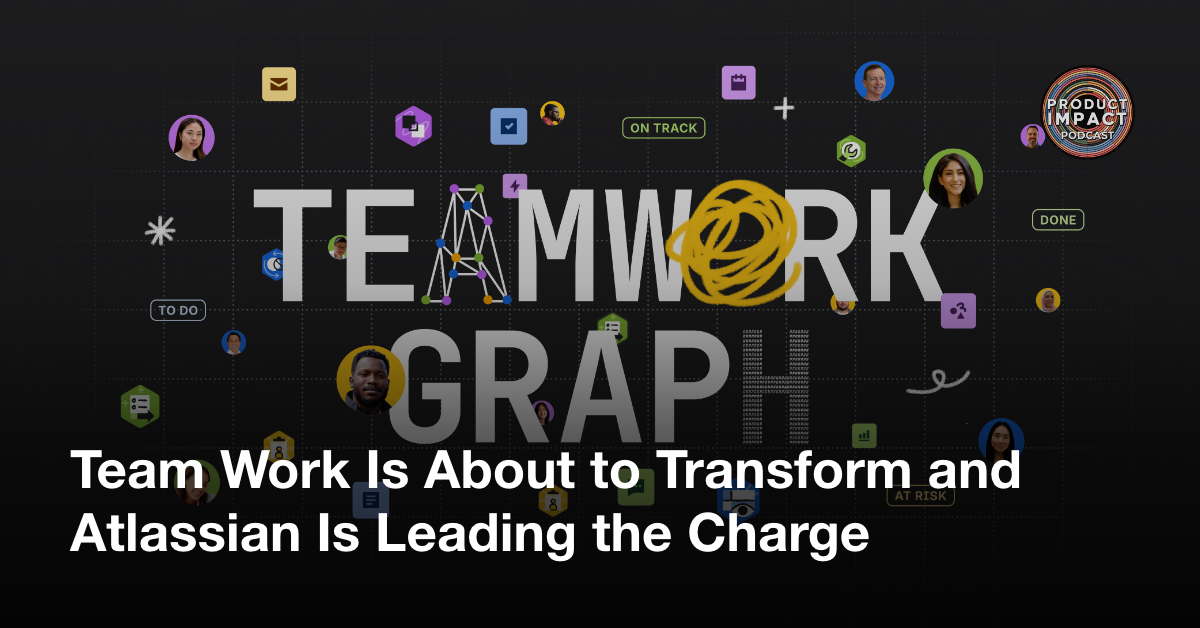
- ● Atlassian's Teamwork Graph announcement signals that 2026 enterprise AI competition is being fought on consolidated context, not on model intelligence.
- ● Microsoft, Glean, Salesforce, Notion, Box, ServiceNow, and Google are all converging on the same architecture: index the messy primary sources, expose them to an agent.
- ● Context graphs erode the information arbitrage that justified middle-management headcount, lining up with the org-flattening thesis Coinbase's Brian Armstrong has been pushing.
- ● Mollick's jagged AI is moving up the stack: agents complete fifty-step refactors and stall on five-minute decisions, because graphs supply context but not intent.
The biggest blocker to scaling AI inside the enterprise has never been the model. It has been organizational structure. Companies were built around verticals and roles because that is how work used to happen, and budgets, hiring plans, and tooling all calcified around the same shape. Engineering wrote in Bitbucket. Marketing wrote in Google Docs. Customer Success logged everything in Salesforce. People operations sat in Workday. Every team manifested its culture in how it stored and labelled data, which meant LLMs and agents inherited a fragmented, inconsistent, partially-undocumented map of the business the moment they were deployed.
Team work is about to change because of context graphs like the one Atlassian announced today at Team ‘26.
Atlassian’s Bet: The Teamwork Graph
At Team ‘26 this week, Atlassian announced its Teamwork Graph across the multi-product platform — a unified context layer spanning Jira, Confluence, Bitbucket, and the third-party systems most enterprises actually run on: Salesforce, Workday, Figma, Microsoft 365, Google Workspace, GitHub. The framing they used in the keynote was simple: acceleration equals context times intelligence. The model side of that equation is largely commoditized. The context side is where the moat now lives.
Atlassian’s positioning here is unusual. Aside from Microsoft, no other vendor sits as deeply inside the everyday operational reality of a modern enterprise. Jira holds the work. Confluence holds the rationale. Bitbucket holds the code. The Teamwork Graph indexes all of it, plus connected systems, in a single semantic layer Rovo can query in plain language. Atlassian’s lens on how businesses actually run — not how they describe themselves in board decks — is the asset most other AI vendors cannot replicate.
What Rovo Actually Does in the Demos
The Rovo demos at Team are doing something the earlier wave of enterprise copilots could not. A leader can ask whether the design system is being used consistently across product lines, and Rovo will scan Bitbucket, GitHub, Figma, and Confluence to surface inconsistencies — tokens drifting, components forked, documentation contradicting implementation. The same query yields a map of where the org is today versus where its design leadership says it wants to go, in language a VP can act on without a six-week audit.
The scale numbers are the part that should make every CTO recalibrate. A query reviewing two billion lines of code returns in roughly two minutes. Indexing reaches into datasets that predate the modern data-centre era — relevant because most enterprise institutional memory is older than the systems currently storing it.
Watching the demos, the more interesting question is who benefits more — the junior employee who finally has the historical scaffolding senior colleagues used to provide one-on-one, or the product leader who can now manage a portfolio at a granularity that used to require a whole PMO. Both, honestly, which is why the org-design implications are uncomfortable.
The 2026 Wave: Every Major Vendor Is Building One of These
Atlassian will not be alone in 2026. Microsoft has been steadily extending the Microsoft Graph and Copilot’s grounding across Teams, Outlook, SharePoint, and Loop, with Copilot Tuning and Agents announcements at Ignite ‘25 pushing further into multi-source enterprise reasoning. Glean continues to position itself as the neutral-vendor enterprise search and reasoning layer for orgs unwilling to commit to a single platform. Notion AI, Box AI for Hubs, and ServiceNow’s Now Assist have each shipped versions of the same idea: index the messy primary sources, expose them to an agent, let the agent reason over the corpus rather than the prompt. Salesforce’s Data Cloud and Agentforce are converging on the same architecture from the CRM side. Google’s Gemini for Workspace has the same ambition with a narrower aperture across Drive, Gmail, and Docs.
Every one of these announcements is selling the same thesis. More context, more reliability, more autonomy. Whoever owns the most accurate map of how a given enterprise actually works will own the agent layer that runs on top of it.
The Org-Design Problem No One Wants to Name
If that thesis holds, the organizational implications are sharper than most leadership teams are willing to acknowledge. Brian Armstrong’s May 2026 Coinbase memo — the latest entry in the CEO layoff-notice genre Product Impact has been tracking — made the case bluntly: flatter orgs with fewer layers can move faster with AI than deep ones, and Armstrong framed his 14% workforce cut — alongside replacing pure managers with player-coaches and capping the org at five layers below the CEO — as a precondition to leveraging AI rather than a consequence of it. Most CEOs read that memo and filed it under “Coinbase being Coinbase.” The Teamwork Graph generation of tools is going to make that filing harder to maintain.
The reason is mechanical. When a product leader can audit consistency across two billion lines of code in two minutes, the middle-management layer whose job was to aggregate that signal upward loses its information arbitrage. When a junior employee can get accurate historical context on demand, the onboarding scaffolding that mid-career managers used to provide informally becomes lower-leverage. Roles that existed to compensate for missing context become harder to justify when the context is no longer missing. The counterpoint Atlassian leaned into during the keynote — that leaders will be more connected than ever to the actual work, and that agents will autonomously audit, act, and accelerate — is true. It is also exactly what flattens the org chart.
Inverting the Relationship With Work
Team work was historically defined by the limits of knowledge transfer. Meetings existed to unblock work the participants could not unblock asynchronously. Slack existed to escalate the conversations that meetings could not surface. Both were workarounds for the fact that humans cannot hold the full context of a project in their heads. With a working context graph, that constraint relaxes, and the purpose of humans-in-the-loop shifts. Verifying intent and impact becomes the human job. Generating artifacts — the deck, the spec, the first-draft analysis, the code review summary — increasingly does not.
Whether this means smaller orgs and fewer offices is genuinely too early to call. What is harder to argue with is that small teams will be capable of materially more output, and that legacy enterprises now have the same disruptive tooling available to them that has been reshaping tech-native companies for two years. The bottleneck has moved from access to adoption.
Jagged Capability Moves Up the Stack
Ethan Mollick’s keynote at Team ‘26 returned to his core argument: AI capability is jagged — superhuman at tasks adjacent to mediocre human performance, surprisingly weak at others adjacent to expert performance. He formalized this in the BCG-Harvard “Jagged Technological Frontier” study and has extended it through his book Co-Intelligence and his One Useful Thing substack.
In 2026 the jaggedness is moving up the stack. It used to show up at the level of single tasks — the model could draft an email but botch the spreadsheet. Now it shows up at the level of complex work — the agent can complete a fifty-step refactor and then stall on what should have been a five-minute decision. Context graphs solve the first jaggedness. They do nothing for the second.
This is the part the keynote energy obscures. Indexing every Confluence page, every Jira ticket, every Bitbucket commit, and every Salesforce note will not surface intent. Confluence holds the artifact that resulted from a strategic decision; it almost never holds the reasoning that produced it. Without intent, agents reason laterally across context until they exhaust the graph, and then they keep going. Anyone who has opened a fresh Claude Code session and watched it act like someone lost on a street corner waiting for direction has seen the small-scale version of the failure mode. Scale that to a hundred autonomous agents inside an enterprise and the problem writes itself.
Mollick said it best himself: no one knows what happens next with AI — all we know is what it is good at and not good at today, and both of those shift every quarter.
What This Means for the C-Suite
The definition of ROI and productivity is about to change in ways finance and HR functions are not yet measuring. The unit of output is shifting from “what one person produced this quarter” to “what one person plus their agents produced this week,” and the gap will be visible to your board within a year of these graphs going into production at competitors.
The work that matters in 2026 is not selecting the right model vendor. It is consolidating context from where your business actually operates — CRM, HRIS, design files, meeting transcripts, codebase, customer history, contracts — into a layer your agents can reason over. Atlassian is one route. Microsoft is another. Glean and the open-source variants are a third. The window to act before your competitors is closing faster than your procurement cycle assumes.
Wait for the org-design playbook to stabilize, and you will be implementing it against competitors who have already absorbed two years of compounding advantage from agents working over their context graph while yours was still in spreadsheets.
Brittany Hobbs, from AI Value Acceleration, is speaking with enterprise leaders about how to translate knowledge graphs and agent orchestrations into measurable value creation. If that is the decision you are inside today, reach out.
How helpful was this article?
Share this article
Latest Episodes ›
All episodes
![21. Career Reinvention in the Age of Agentic AI [Christian Crumlish]](https://d3t3ozftmdmh3i.cloudfront.net/staging/podcast_uploaded_episode/40697999/40697999-1788965600708-228665e06d0cd.jpg)

Enterprise Context Is the AI Moat Nobody Built: Knowledge Graphs, Taxonomies, and Why Models Aren't Enough
The Time-Suck Era of AI Is Ending. Design Decides What Comes Next.

Your Approvals Are Teaching AI to Skip You

The UX Researcher's Guide to Claude, Claude Cowork, and Claude Code
WTF is an AI-native org anyways? Let's compare Airbnb & Meta's opposing plans.

Future of UX Research: Guide for How UX Researchers Can Protect Their Jobs & Careers
Product Impact Newsletter
AI product strategy delivered weekly. Free.