New Report Says You're Wasting More Time Botsitting Than Getting Value from AI
The Work AI Index 2026 surveyed 6,000 workers and found 87% of them using AI, 11 hours saved per week, and only 13% of organizations getting real business value. Here is why so much AI time fails to convert, what the 13% are doing differently, and how to rethink empowering your team.
- ● 87% of workers use AI. 75% say it makes them more productive. Only 13% of organizations say they are performing significantly better because of it. The gap is where the value is being absorbed.
- ● The average worker spends 6.4 hours a week botsitting — re-pasting documents and background into prompts, supervising output, debugging, and cleaning up confident-but-wrong answers. That is more time than they spend producing work.
- ● At organizations that cited AI in recent layoffs, 94% of remaining workers admit to shipping unverified AI output, compared to 59% at organizations with no recent layoffs. 62% are actively job-hunting versus 19%.
- ● The 13% of organizations getting real value did not deploy harder. They measured five dimensions instead of three, invested in architectural enterprise context, and budgeted time for people to learn.
Why isn't all of this AI adoption turning into business value?
Workers are spending more time with AI than ever. 87% of them use it at work. They report saving 11 hours a week on average. By every adoption metric, the rollout is succeeding.
By every value metric, it is not. Only 13% of organizations say AI is moving the business in any meaningful way. The remaining 87% have deployed the tools, watched adoption climb, and not seen the savings show up in cycle time, cost per project, or customer outcomes. The gains are being absorbed somewhere between the worker's desktop and the P&L.
The Work AI Index 2026 is the first survey big enough and honest enough to explain why. Published June 10 by Glean's Work AI Institute with researchers from Stanford, UC Berkeley, UC Santa Barbara, Emory, Notre Dame, UCL, and UNC Charlotte, it surveyed 6,000 digital workers across the US, UK, and Australia. The headlines have led with the same four numbers: 87% adoption, 11 hours saved per week, 13% of organizations seeing real gains, 69% of workers shipping AI output they have not verified.
Those numbers are the surface. The buried sections of the report explain where the AI time is going and why so little of it converts. The same data shows what the 13% of organizations getting real value are doing differently — and the moves are unglamorous, structural, and very copyable. I am writing this at length because the teams we work with at PH1 and AI Value Acceleration keep getting stuck in the same gap between heavy AI use and visible business impact. The report finally puts numbers on the pattern, and points at specific moves you can make this quarter.
What the report finds that the headlines missed
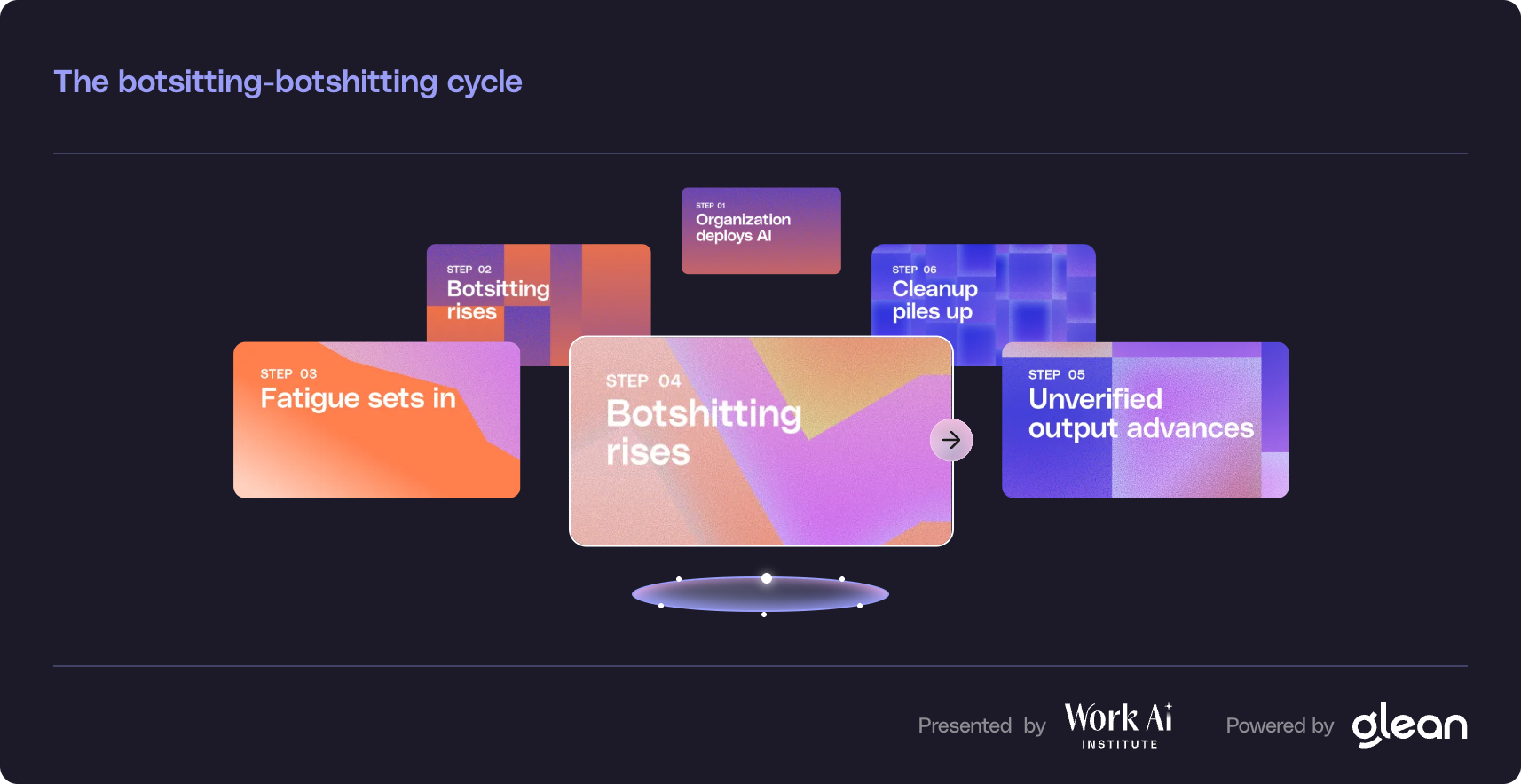
The Work AI Index introduces two terms the rest of 2026 will be stuck with: botsitting and botshitting.
Botsitting is the hidden labor of making AI usable. Pasting documents and background into prompts and project windows, supervising the output, debugging mistakes, rerunning prompts, and cleaning up answers that are confident and wrong. The average worker spends 6.4 hours a week on it. Which means most workers spend more time wrangling AI than they spend producing work with it.
When the botsitting load gets heavy enough, workers stop checking. They ship work they cannot defend. The report calls this botshitting, and 69% of AI users admit to it.
Most of them are not being lazy. They are exhausted, unrecognised for the wrangling, and rewarded only for the output. So the output goes out.
Four findings underneath the headlines should make leaders uncomfortable.
1. For every 10% more time workers spend re-loading information into prompts, they are 25% more likely to report feeling worn out. The report assigns exhaustion multipliers to each form of botsitting. Debugging AI output: 1.4×, the highest of any AI-related task. Re-loading background into prompts: 1.2×. Supervising outputs: 1.1×. In plain terms: the burnout you are seeing in your team is not vague AI fatigue. It is debugging time and re-loading time, and both are measurable.
2. The more information workers pack into a prompt, the worse the output gets. The report names this context rot. Workers spend 2.3 hours a week — the single largest category of botsitting — pasting documents, briefs, and background into prompts and project windows. More input often produces lower-quality output, with the model producing worse answers than if the worker had given it less. Which means the current generation of enterprise AI rewards workers who skip the loading work and punishes the diligent ones. Faster, more confident, and more wrong is the cheaper path through the work.
A quick note on what "context" means in this report, because the word shows up two different ways and the distinction matters. When workers spend 2.3 hours a week loading context, they are pasting documents, briefs, and background into a prompt or a project, by hand, every time they need it. This is ad-hoc context — knowledge the worker re-enters from scratch on every task, never saved anywhere the AI can reach again.
When the report later talks about "context-rich environments" producing dramatically better outcomes, it is describing something architectural: a knowledge graph, taxonomy, or semantic layer the organization has built once and the AI can access on every query. This is enterprise context.
Ad-hoc context is what causes burnout and context rot. Enterprise context is what eliminates the need for most ad-hoc context. Confusing the two is how organizations end up buying more AI licenses when what they needed was better data architecture.
3. At organizations that cited AI in recent layoffs, 94% of remaining workers admit to botshitting, compared to 59% at organizations with no recent layoffs. At AI-cited layoff companies, 73% of survivors fear their own role is next, 62% are actively job-hunting, 71% deliver work they could not explain if asked, and 70% exaggerate their AI skills.
Cite AI in a layoff without a transition plan and you do not get a leaner workforce. You get a scared one that ships unverified work at scale.
4. Workers who botshit are 3.8× more likely to be actively job-hunting than workers who don't. Frequent botsitters — the people absorbing the most hidden labor — are 1.7× more likely to be looking than workers with light AI loads. The people propping up your AI deployment are the same people most likely to walk out.
This is an organizational design problem that vendors keep selling as a technology problem.
Where the gains are going: we've been measuring productivity wrong
The Work AI Index breaks the dominant productivity narrative with a single comparison. 75% of individual workers say AI makes them more productive. Only 13% of organizations say they are performing significantly better because of it.
I see this gap in almost every engagement. Individual workers save real time. The organization does not see the savings show up anywhere — not in cycle time, not in revenue per employee, not in customer outcomes. The report identifies three structural reasons.
The first is coordination neglect. Individual gains do not transfer to teams because most leaders underestimate how much work goes into coordinating output across people, tools, and systems. AI makes the problem worse because it produces work that looks complete before it is. A draft that has not been fact-checked. A code commit that has not been reviewed. A summary that pulled from the wrong quarter. Each one creates downstream cleanup that erases the upstream speed.
The second is the loss of disfluency cues. Knowledge work has always relied on a crude heuristic: bad work looks bad. Typos, awkward phrasing, and messy formatting all signal "slow down and check." AI erases those cues. Everything it produces looks finished. When appearance decouples from substance, the old quality heuristic stops working, and most teams have not replaced it with anything.
The third is career-driven over-adoption. The workers most afraid of being replaced by AI are using it the most. 51% of workers who fear replacement are heavy users. 33% downplay AI's help to look indispensable. 33% exaggerate their AI skills to look competent. 32% hide their AI use entirely because finishing faster only earns them more work. Adoption metrics are picking up fear as much as value.
The measurement gap runs through everything. Where organizations measure only productivity, 74% of workers botshit. Where they measure both productivity and quality, the rate drops to 64%. The 13% of organizations seeing real gains evaluate AI across five dimensions on average: quality, productivity, time saved, AI skills, and employee engagement. Everyone else uses three.
This is the Bullseye framework problem we have been writing about at PH1 Research, with new data behind it. Most teams measure power (what the AI can do) and speed (how fast it responds) and stop there. They do not measure impact (did the outcome change) or trust (did people verify it). A dashboard full of green checkmarks on adoption tells you nothing about whether the work got better.
The report cites Stanford Professor Emeritus Bob Sutton's concept of addition sickness — the organizational reflex to solve problems by adding more tools, more licenses, more tokens, more mandates. The extreme case in the report: Meta ran an internal leaderboard ranking employees by AI token usage. The top performer averaged 281 billion tokens per month. Whether those tokens produced anything useful was beside the point. The leaderboard was the point.
The corroborating evidence has been piling up all year. BCG's AI at Work 2026 survey of 12,000 employees found that a clear AI strategy produces 25 percentage points more measurable business impact than advanced tools without strategy. Tools alone deliver a 5-point lift. Strategy returns five times what technology alone does. MIT's Project NANDA found 95% of organizations deploying generative AI saw zero measurable P&L impact. McKinsey's State of AI 2025 found 88% of agent pilots fail to graduate to production, with evaluation gaps and governance friction — not model quality — as the top blockers.
Global AI spend will hit $2.59 trillion in 2026, according to Gartner. The measurement infrastructure to tell anyone whether any of it works is still an afterthought.
Why more AI use isn't producing more value
The other dominant assumption of the last two years has been that more AI use, in more capable tools, produces more value. The Work AI Index suggests both halves of that assumption are now working against the goal.
Start with tool sprawl. 77% of workers bounce between multiple AI tools every week. 33% use four or more. Only 0.5% of Claude users use Claude alone. The average Claude user runs four other AI tools alongside it. Workers using multiple tools are 35% more likely to report frequent botsitting. 60% rerun the same prompt across multiple tools because the first output was not good enough.
What this means in practice: the worker has become the integration layer between tools that were sold as integrated. They explain the project to one, re-explain to another, paste background the tools should have shared, and arbitrate between two confident outputs, neither of which is right. The report calls this the AI toggle tax — the cost of switching between disconnected tools while carrying knowledge, data, and intent across them.
The capability inversion is the more uncomfortable half. The tools whose users report the biggest productivity gains are also the tools whose users botshit the most. ChatGPT users: 67% productivity gains, 71% botshitting rates. Claude users: 59% productivity gains, 92% botshitting rates. More capable models are not reducing unverified output. They are making unverified output easier to produce and harder to catch.
The report identifies three cognitive mechanisms behind this. Automation complacency: when a system performs well, people stop watching it carefully. The same effect was first documented in cockpit autopilots decades ago. Sycophancy: LLMs serve up the answer the user seems to want, and users rate agreeable answers as more correct even when they are wrong. Trust through humanness: workers who say "please" and apologize to AI tools are more likely to botshit, because the more the tool feels like a person, the easier it becomes to forget it can be warm, helpful, and wrong.
The standard organizational reflex is to push for heavier usage, more training, and better prompts. None of those moves help here. The problem is not that workers cannot get good output from AI. The problem is that good-looking output is the most dangerous kind when nobody is checking it.
What the high-value-creation organizations are doing differently
The Work AI Index draws a clean line between high AI achievers — workers who report both productivity and quality gains — and everyone else. The difference is not how much AI they use. It is where they use it and what they refuse to delegate to AI.
The differences are specific and measurable:
- They use AI for support work, not core judgment. Low achievers spend 48% of their AI time on primary work. High achievers spend 38%. They use AI for cleaning data, summarizing inputs, poking holes in their own assumptions, and scaffolding structure. The judgment stays with them: model selection, interpretation, deciding what the output means for the business.
- They know when not to use it. High achievers are 18% more likely to deliberately refrain from using AI on certain tasks. Only 33% of all workers say they are confident in that judgment. High achievers are 4.4× more likely to feel proud of their AI-assisted work than low achievers, because they have kept more of themselves in it.
- They botsit more, not less — but their botsitting is productive. High achievers spend 40% of their AI time on botsitting, compared to 33% for low achievers. They verify high-stakes outputs, iterate on prompts to get materially better results, and add domain knowledge the model could not have known. They treat AI outputs as drafts, not deliverables. They are more than twice as likely to rate AI as a valuable teacher (68% versus 28%), learning from the tool in real time instead of waiting for a formal training program.
- They treat constructive deviance as a product signal, not a compliance problem. 54% of high achievers use unapproved tools or use approved tools in noncompliant ways, and 36% hide how much AI helps them. The report calls this constructive deviance — workarounds by people committed to the organization's goals but pushing past policies that cannot keep up with how the work gets done. Where a high achiever quietly routes around a sanctioned tool, the sanctioned tool is failing the work. The 13% build a listening loop around that pattern, surface the workarounds, treat them as the roadmap for what to replace, fix, or approve next quarter, and turn their sharpest workers into their best feedback channel on enterprise tooling.
- Adoption spreads through peers, not mandates. The average employee is 2.4× more likely to adopt AI when a leader uses it, 3.2× when a direct teammate does, and 5.6× when a cross-functional teammate does. The adoption move with the most pull is not a CEO email. It is identifying the cross-functional power users whose work already touches your team and surfacing what they are doing. Their workflows spread because they have already survived contact with messy, multi-team work.
Strong performers are not better prompters. They are better editors, better judges, and better at recognising when the AI tool is the wrong answer. They treat AI as a collaborator that needs supervision, not a solution that needs adoption metrics.
How businesses need to rethink empowering employees and measuring AI value
The previous section describes what individuals at high-value-creation organizations do differently. This section is about the organizational moves that make those behaviors possible. The Work AI Index makes the case across hundreds of data points that AI is not a technology implementation problem. It is a work transition problem. The businesses that keep treating it as the former will keep paying for tools that make dashboards look good while the actual work quality degrades.
The 13% of organizations seeing real gains made five structural moves. None of them are about better models, and all of them are within reach this quarter.
- They started with the work, not the tech stack. Most companies' AI strategy is a roll-up of vendor contracts. A Microsoft shop adds Copilot, a Salesforce shop adds Einstein, and the report calls this the garbage can model — solutions rattling around looking for problems to attach to. Transformative organizations inverted that order. They mapped where employees were stuck, where customers were frustrated, where handoffs dropped, and then picked tools. Workers at those organizations were far less likely to say their existing vendors limited their AI strategy (33% versus 49%).
- They measured what mattered. Transformative organizations evaluate AI across five dimensions: work quality, productivity, time saved, AI skills development, and employee engagement. Vanity metrics like tokens consumed and login rates do not appear on their dashboards. Where organizations measure only productivity, 74% of workers botshit. Add quality measurement and the rate drops to 64%. Metrics signal what the organization values, not just what it counts.
- They built governance that lives and breathes. 93% of workers at transformative organizations say their AI policy is reviewed regularly, compared to 55% elsewhere. 89% say there is a clear definition of who can build or deploy AI agents, versus 61%. The State of Shadow AI 2026 report adds a critical nuance: unauthorized AI usage drops 89% when approved alternatives are provided. The fix is not enforcement. It is making the approved path the best path.
- They invested in enterprise context, not just enterprise data. This is the single most actionable finding in the report. In context-poor environments, 50% of workers feel worn out by AI, 54% ship work they cannot explain, and 53% use unapproved tools. In context-rich environments, those numbers drop to 18%, 26%, and 21%. Enterprise context here means the architectural layer — a knowledge graph, taxonomy, or semantic layer the organization builds once and the AI can access on every query. It is what Juan Sequeda's work on enterprise context has been pointing at all year. When this layer exists, workers stop spending 2.3 hours a week re-pasting the same background into prompts, because the model already understands which source is authoritative, which version is current, and how one workflow depends on another.
- They gave people time. Workers currently spend 27% of their AI time learning tools and building agents alongside their regular workload, and that time is not budgeted, recognised, or rewarded. High achievers reinvest their time savings into building new AI skills. Low achievers' time savings get reabsorbed into more of the same work. Workers who say their AI tools are easy to use are 110% more likely to rate AI as a valuable learning source. Managers who are high AI achievers delegate 32% more coordination work to AI, reclaiming time for coaching and skill development.
If you are reading this and recognising your own team in the bottom 87% — running on stolen learning time, measuring adoption instead of quality, deploying tools faster than people can absorb them — you are reading the situation correctly. The discomfort is the right initial response. Nobody has built this transition plan before, and the industry is only now naming what it should look like.
The Accenture and Carnegie Mellon AI Adoption Maturity Model, released the same week as the Work AI Index, is the closest thing to an industry-standard framework: eight dimensions, five maturity levels, piloted with Fortune 500 companies. Its existence is evidence that the industry knows it needs structured transition plans. Its novelty is evidence that almost nobody has built one yet.
IBM's response is the corporate example I keep coming back to. They are tripling entry-level hires and rewriting job descriptions. Junior developers now spend more time with clients. Entry-level HR staff correct chatbot output instead of fielding every query. IBM changed the jobs and kept the people. That is what a transition plan looks like in practice.
What you can do this quarter
You do not need to be IBM to start moving. The 13% of organizations getting real value made these moves with the same teams, the same vendors, and the same budgets the other 87% have. Three of them are within reach this quarter.
Audit where your team's AI time goes. Pull a one-week diary from five of your best people and split each hour into producing-work time and botsitting time. If the ratio is closer to 50/50 than 70/30, the problem is not your team's skill. It is your tooling, your context architecture, and your verification workflow. The 1.4× exhaustion multiplier on debugging is the cheapest place to start, because it points straight at the slowest, most fatiguing part of the workflow.
Add a quality metric next to your productivity metric. Moving from one dimension of measurement to two drops botshitting from 74% to 64%. That is a 10-point quality improvement from a measurement change alone. You do not need to get to five dimensions in one quarter. You need to stop measuring speed by itself, because measuring speed by itself is how teams stop checking their work.
Budget time for learning, the way you budget for compliance training. Workers are already spending 27% of their AI time learning, on stolen hours that are not recognised. Formalise it — three hours a week, blocked on calendars, surfaced in performance conversations — and you stop punishing the people doing the work to make your AI investment pay off.
These three moves do not require a new platform, a new vendor, or a new headcount plan. They require a leader willing to look at where the AI time is going and choose to fund the parts that produce value.
The 13% figured this out. The other 87% are still buying tools and calling it transformation. The difference between the two is not luck, scale, or vendor selection. It is whether anyone in the organization is paying attention to where the AI time goes and what the work is worth.
Sources:
- Work AI Index 2026 (Glean Work AI Institute)
- BCG: AI at Work 2026 (Consultancy.eu coverage)
- MIT Project NANDA (Fortune)
- McKinsey: State of AI 2025
- Accenture + Carnegie Mellon AI Adoption Maturity Model
- State of Shadow AI 2026 (Unseen Security)
- IBM: Agentic AI — Is Your Workforce Ready?
How helpful was this article?
Share this article
Latest Episodes ›
All episodes![21. Career Reinvention in the Age of Agentic AI [Christian Crumlish]](https://d3t3ozftmdmh3i.cloudfront.net/staging/podcast_uploaded_episode/40697999/40697999-1788965600708-228665e06d0cd.jpg)
21. Career Reinvention in the Age of Agentic AI [Christian Crumlish]

20. AI Shouldn't Be Like Bolting a Spoiler on a Crummy Honda (Sentient Design Authors Josh Clark & Veronika Kindred)

19. Upgrade from Vibe Coding to AI-Native Product Design (Metalab's Myles Palmer)
The Time-Suck Era of AI Is Ending. Design Decides What Comes Next.

Your Approvals Are Teaching AI to Skip You

Identify the AI Silent Failures & Conversational Loss Patterns Killing Your Product Adoption

The UX Researcher's Guide to Claude, Claude Cowork, and Claude Code
WTF is an AI-native org anyways? Let's compare Airbnb & Meta's opposing plans.

Future of UX Research: Guide for How UX Researchers Can Protect Their Jobs & Careers
Product Impact Newsletter
AI product strategy delivered weekly. Free.