The AI Job Apocalypse Won't Happen. Here's What Will.
Ezra Klein says the job count won't collapse, and the research agrees. That doesn't help the generation whose entire career path just became structurally cheaper.
- ● Pull together all the research from the last year and you get three very different pictures.
- ● I said rebuilding the org chart makes more financial sense under current investor pressure.
- ● What the numbers miss is this: a generation did everything right.
- ● The question I keep coming back to is whether any organization has actually figured out how to reorient a workforce without discarding the people in it.
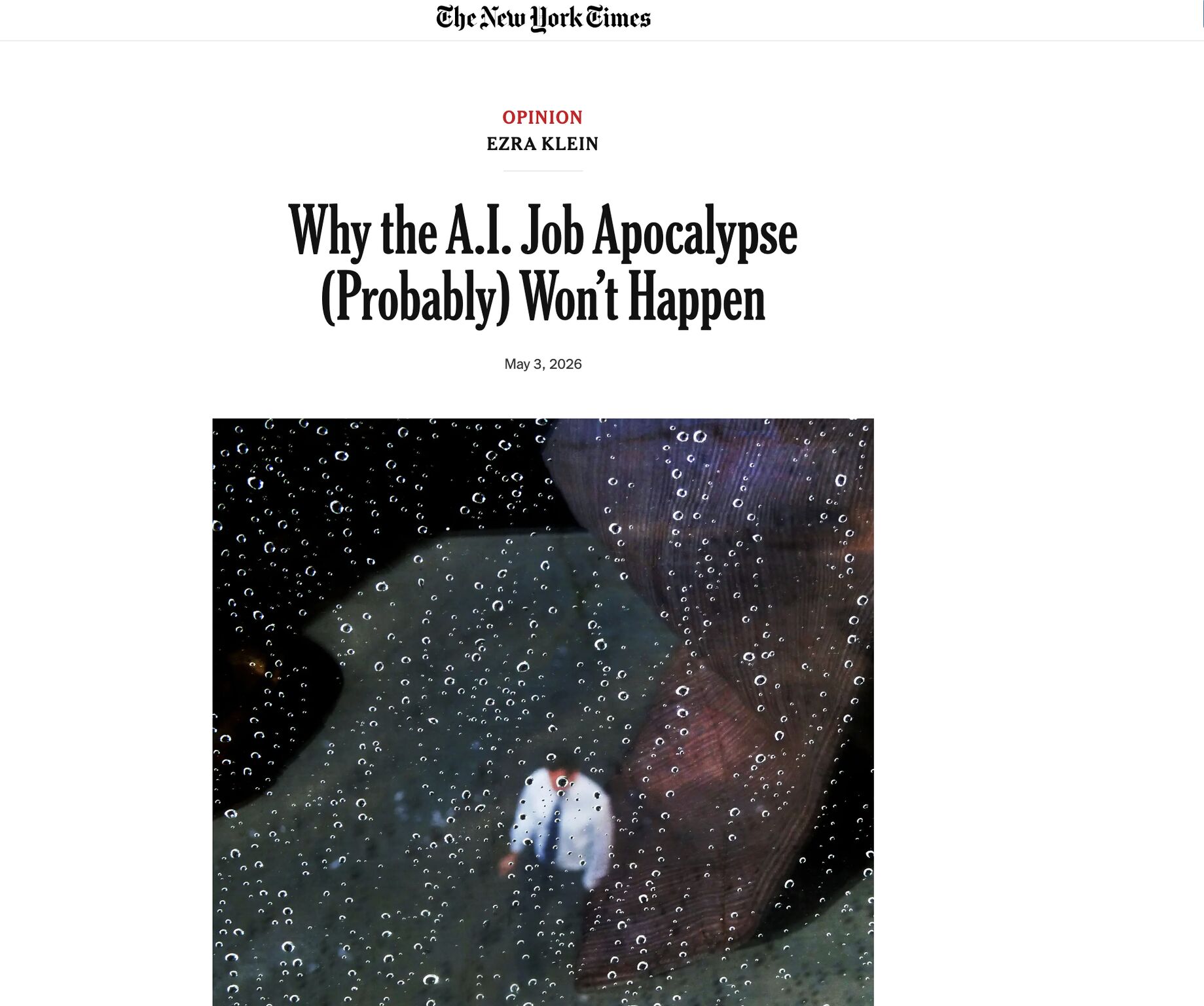
On May 4, Ezra Klein published “Why the A.I. Job Apocalypse (Probably) Won’t Happen” in the New York Times. It’s worth reading carefully — economically rigorous, grounded in solid historical frameworks, and it arrives the same week Microsoft published its 2026 Work Trend Index, a survey of 20,000 workers across 10 countries showing agents on Microsoft 365 grew 15 times year-over-year.
Klein’s case: when AI automates one category of work, scarcity shifts to whatever AI can’t do yet. Demand follows scarcity. The economy created new jobs after ATMs, after the loom, after every major automation wave. The aggregate count didn’t collapse. It adapted.
He’s right. And buried in the piece is the warning that matters more: concentrated displacement is politically harder to address than mass displacement. If AI disrupted eighty million workers across every sector simultaneously, the pressure to respond would be proportional — a crisis that visible can’t be ignored.
Eight million workers concentrated in specific roles, specific age bands, specific sectors lands differently. Too targeted to generate the political momentum mass disruption demands. Large enough to permanently reshape those workers’ careers. No adjacent category absorbs them. No policy infrastructure scales to the problem.
What the data is actually showing isn’t a wave. It’s landing on specific people, in specific roles, at a specific point in their careers. And that precision is exactly what makes it politically invisible — and personally devastating.
Where the Views Actually Land
Pull together all the research from the last year and you get three very different pictures. Understanding why they disagree tells you more than picking a side.
The “net positive” camp. Klein, MIT economist David Autor, the Yale Budget Lab, the Peterson Institute, BCG’s 2026 analysis, the Anthropic Economic Index, and HBR’s labor research all converge: aggregate employment effects are limited, and AI is reshaping more jobs than it replaces.
The WEF Future of Jobs Report 2025 makes the case quantitatively — 92 million roles displaced by 2030, 170 million created, net positive 78 million. The Anthropic Economic Index found no clear unemployment spike in AI-exposed occupations overall. By every broad measure right now, the labor market is functioning normally.
The “concentrated displacement happening now” camp. Stanford’s “Canaries in the Coal Mine” tracked millions of American payroll records and found a 13–16% employment decline for early-career workers aged 22–25 in AI-exposed roles, while mid-career workers in those same roles were stable or growing. Entry-level software engineering and customer service fell nearly 20%.
The Stanford HAI AI Index 2026 confirmed the same pattern: under-25 developers down nearly 20% since 2022, while developers in their 30s and 40s at the same companies grew 6–12%. Yale CELI research captured the mechanism: agentic AI doesn’t cut entry-level roles suddenly — it narrows the opportunities that never materialize. Goldman Sachs put a pace to it: roughly 16,000 net jobs lost per month, with Gen Z absorbing most of the hit.
The announcements this week are the same data in real time. PayPal cut 4,760 people on May 5 — 20% of its workforce — with CEO Enrique Lores framing it as “becoming a technology company again.” The day after, Freshworks announced 500 cuts (11%), with CEO Dennis Woodside: “More than half of our code is now being written by AI.”
We analyzed the CEO layoff memo pattern at length: in every case the framing shifts from cost to identity, which forecloses any return to previous headcount as a brand decision, not just an efficiency one. For the people receiving those announcements, that distinction matters — the job is not coming back when conditions improve. HBR calls this reverse skill bias: higher-educated knowledge workers are hit hardest because their tasks are most automatable.
The “huge displacement coming” camp. Dario Amodei says 50% of entry-level white-collar work will be eliminated in one to five years. Jensen Huang projects 100 AI agents per human employee — at Nvidia’s 75,000 headcount, that’s 7.5 million agents, the operating math behind Amodei’s outcome.
Jamie Dimon says retraining infrastructure doesn’t exist and government has to build it — a direct admission that voluntary private-sector action won’t be enough. At Davos in January 2026, most public CEOs pushed back on Amodei’s timeline. But the gap between what executives say in public and what their operating decisions show is itself a signal worth watching.
They’re not actually contradicting each other. They’re all looking at the same situation from different distances. The overall job market looks fine from far away. Zoom in, and you see specific groups of people getting hit hard, with no policy or organizational infrastructure in place to catch them. Each view is true on its own. The problem is what happens when you only read one of them.
The emerging fourth camp: layoffs don’t deliver ROI anyway. A Gartner study published May 5 — 350 companies with more than $1B in revenue — found that AI-driven layoffs consistently underperform against AI-driven augmentation. Distinguished VP Analyst Helen Poitevin: “Many CEOs turn to layoffs to demonstrate quick AI returns; however, this disposition is misplaced … Organizations that improve ROI are not those that eliminate the need for people, but those that amplify them.”
If that finding holds at scale, the PayPal and Freshworks announcements this week aren’t just displacement stories — they may be strategic errors that surface in a few years’ earnings reports. The companies moving fastest to cut headcount may end up with the worst long-term outcomes, while the costs land entirely on workers who had nothing to do with the decision.
But one question cuts through all of it: why are the people who built this technology the most pessimistic? Amodei reads Anthropic’s own deployment pipelines. Huang is building the physical infrastructure for the agent economy. Dimon runs the institution most exposed to white-collar labor. These aren’t people reading headlines — they’re reading deployment trajectories in real time, from the inside.
If the people with that visibility are more worried than the people reading lagged statistics, shouldn’t that be treated as a signal rather than an outlier? Shouldn’t it put the burden of proof on the optimists?
Here’s my honest read: no model or study can actually tell us what’s coming. Nothing like this has happened in history before. Every previous automation wave unfolded over decades. This one is moving in months.
I see it at every conference I attend. You go in expecting panels on AI strategy. You leave having watched a live demo that changed what you thought was possible — and quietly running the math on how many roles in your industry still make sense in eighteen months, not five years.
The displacement will be massive. The only real question is whether leadership will choose to upskill their teams or redraw the org chart. I’ve watched both decisions get made. And I’ll be direct: rebuilding makes more financial sense in an era where investor pressure is this intense. That’s what no study captures — and what your people are quietly waiting to find out.
If You’re Leading the Reorganization
I said rebuilding the org chart makes more financial sense under current investor pressure. I want to be honest about why that’s still the wrong call in the long run.
The reason is structural. Most senior judgment was built by years of doing the junior version of that work first. Automate away the junior work and you don’t just cut headcount — you cut the pipeline that produces your next generation of leaders. That gap is invisible today and critical in five years.
Gartner’s study of 350 large companies found AI-driven layoffs consistently underperform against augmentation. McKinsey found 77% of organizations plan to upskill workers, while only 1% describe themselves as mature on AI deployment. Planning to upskill is not the same as knowing what to upskill toward.
A few moves that actually matter:
- Map how judgment was built before you automate what built it. If the answer was years of junior execution, that pipeline is now at risk and you need a deliberate replacement.
- Build AI-native development paths. Oversight of agent output, structured stretch assignments with senior review, cross-functional rotation before the junior execution roles that created range are gone.
- Hold human-in-the-loop touchpoints on purpose. Klarna automated customer service to zero, lost quality, and reversed course. That lesson is expensive to learn twice.
- IBM went the other direction and tripled US entry-level hiring. CHRO Nickle LaMoreaux called layoffs a “false economy” in an AI-driven world. The Gartner data backs this: companies that augment people outperform companies that replace them.
- Be direct with your team about what’s changing. People who get corporate euphemism while the floor moves underneath them stop trusting leadership in ways that don’t heal.
If You’re the One Being Displaced
What the numbers miss is this: a generation did everything right.
They were told knowledge work was safe — that physical labor was automatable, cognitive work wasn’t. Many paid $60,000 to $120,000 for the credential. They chose software engineering, UX design, financial analysis, customer success — roles that were supposed to be on the stable side of the automation divide. They’re now the ones bearing the cost.
This isn’t the Rust Belt. That displacement took two to three decades, was geographically concentrated, and at least pointed somewhere: retrain, move, learn to code. There’s no equivalent direction now. Software engineers are told to learn AI, but the entry-level engineering work that was the onramp is gone. UX researchers are told to add AI tools, but the research execution roles that built their judgment have been eliminated.
The reorientation required is not “learn a new skill” — that’s what you do when tools change. This demands abandoning the premise that a career is a path you follow. The shift is from “I am a software engineer” to “I am someone who solves problems with whatever tools are current.”
That’s not an identity shift a retraining program addresses. There’s no infrastructure for it. Klein is right that judgment becomes the next scarce resource — but that’s cold comfort if your path to developing judgment ran through the work that’s been automated.
Here’s what the path forward actually looks like right now.
Microsoft’s data shows 16% of AI users have reached Frontier Professional status — orchestrating agents across workflows, producing work they couldn’t have done a year ago. The gap between them and the 42% still finding their footing is widening now. The agent stack is not optional. Self-directed practice puts you on the right side of that gap before it closes.
Redefine what you’re being paid for. Output is cheap. Judgment — knowing what the output means, whether to trust it, what to do next — is what this decade rewards. The question is no longer “what can I produce?” It’s “what changes because I was in the room?”
If you’re early-career, optimize for range and senior exposure, not volume of routine execution. The implicit deal — execute, develop judgment, get promoted — is breaking.
The skills that matter now aren’t listed on most job descriptions: knowing which agent to trust and when to override it, translating AI output into a decision a room will act on, synthesizing across domains that used to require different departments. The new deal is: orchestrate the agents, get close to senior decisions, develop judgment fast. That path is available to people who seek it now.
The Signal I’m Still Tracking
The question I keep coming back to is whether any organization has actually figured out how to reorient a workforce without discarding the people in it. Retraining programs fill a compliance box. Genuine reorientation — helping people whose career identity has been structurally disrupted find meaningful work on the other side — barely exists in the research literature yet. If you’re a leader who has navigated this, I want to hear from you.
Because underneath all the economics is a harder truth: work isn’t just income. It’s purpose. The disappearance of the career ladder — the loss of the onramp that was supposed to lead somewhere — is a purpose crisis. The organizations that come out of this era with their people intact will be the ones that treated that as the central problem, not a soft afterthought to the efficiency math.
How helpful was this article?
Share this article
COO, PH1 · CEO, AI Value Acceleration · Co-host, Product Impact Podcast
Latest Episodes ›
All episodes
![21. Career Reinvention in the Age of Agentic AI [Christian Crumlish]](https://d3t3ozftmdmh3i.cloudfront.net/staging/podcast_uploaded_episode/40697999/40697999-1788965600708-228665e06d0cd.jpg)

Your Approvals Are Teaching AI to Skip You

Future of UX Research: Guide for How UX Researchers Can Protect Their Jobs & Careers

Lenny's 2026 Tech Survey: AI Burnout Is Surging, Layoff Fear Is High

The UX Researcher's Guide to Claude, Claude Cowork, and Claude Code
WTF is an AI-native org anyways? Let's compare Airbnb & Meta's opposing plans.

The Free Ride Is Over: AI Economics Is Now Your Most Important Strategy Decision
Product Impact Newsletter
AI product strategy delivered weekly. Free.