12 Things Knowledge Workers Need to Know From the AI Strategy Summit
The Section AI Strategy Summit was designed for executives. Here's the cut that's actually for you.
- ● Greg Shove's blunt take: companies are over-investing in AI infrastructure and massively under-investing in the adoption layer — which is where your job lives.
- ● Scott Galloway: 'It's never a cheaper time to experiment. You're being subsidized by Sequoia Capital right now.' That window closes when the IPOs hit.
- ● Section's survey of 5,000 knowledge workers: 67% use AI weekly, but only 5.5% are proficient. That gap is the opportunity.
- ● 79% of managers haven't demonstrated their own AI use to their team in the last month. You're largely building this skill on your own.
- ● 40% of knowledge workers have access to agentic tools. Only 16% use them. That gap separates today's experimenters from tomorrow's proficient tier.
On June 5, 2026, Section hosted one of the most comprehensive AI strategy events of the year — and we've pulled out the most important takeaways for knowledge workers. The summit was designed for Heads of AI and senior leaders: hire a head of AI, build a governance framework, launch a proficiency program. The speaker lineup reflected that — Greg Shove (CEO, Section), Scott Galloway (Co-host, Pivot), Lasherelle Morgan (SVP, AI Innovation & Acceleration, NBCUniversal), Ryan Asdourian (Chief Strategy & Marketing Officer, Lumen), Amol Phadke (Chief Transformation Officer, Tech Mahindra), Scott Likens (Global Chief AI Engineer, PwC), and Patrick Murta (VP of AI Solutions, Centene).
Most of the day was framed for the executives in the room, but much of what was said will help you navigate the rapidly changing corporate AI environment. Section also shared results from their biannual AI Proficiency Survey of 5,000 knowledge workers that puts real numbers behind the changes you're already feeling.
1. You're being subsidized right now — use it
Scott Galloway was predictably direct: "We're being subsidized by Sequoia Capital and IPO investors right now — never a cheaper time than now to be experimenting with AI. Max it out and learn subsidized." Galloway put the scale of what's coming in plain terms: $150 billion in fresh capital raises from three companies — including Anthropic and OpenAI — hitting the market, with valuations that require them to grow market share fast before the math doesn't work anymore.
That changes once the IPOs hit and the economics normalize. The window where experimentation is effectively free is open now. The restructuring that follows when it closes is already underway. If you're waiting until your organization formally asks you to develop AI fluency, you're waiting on someone else's timeline.
2. Build your AI stack before your performance review asks for it
The practitioners who win this aren't the ones who respond to a directive. They're the ones who built their infrastructure before anyone asked them to — a personal AI system that holds their work context, their standards, their client memory, their quality bar. The longer someone else has been building it, the harder it is to replicate.
Lumen's Ryan Asdourian described the same dynamic at the company level. They introduced quarterly awards for best Copilot usage, best AI usage, best growth mindset — and found that employees started sharing what they were actually doing: "what are the right prompts, what are the right way to ask." The culture of AI use grew from giving people a reason to surface their practice, not from mandating it.
3. The more we all use the same models, the more we all sound the same — get outside
Scott Galloway made a point that cuts against almost everything else said at the summit: the answer to some of your most important professional challenges is not more AI. It's more face-to-face time with people who see the world differently than you do.
When everyone is running the same models and prompting from the same defaults, the outputs converge. Work product becomes harder to distinguish. AI accelerates production — but if what you're producing is indistinguishable from everyone else using the same tools, speed doesn't help you.
The antidote is human input that doesn't come from a model. Specifically, provocateurs — people in your professional circle who challenge your assumptions, push back on your framing, and bring perspectives that no LLM will generate. A mentor from a different industry. A peer who disagrees with you productively. The practitioners who stay differentiated in an AI-saturated market aren't just the ones who use AI best — they're the ones who feed the most interesting, divergent human thinking into what they direct. The concentration of value happening right now will reward the people who are genuinely different, not the ones who are just faster.
4. Stop measuring AI ROI — measure return on experiments instead
Scott Likens at PwC put the CFO problem plainly: "Tokenomics or tokenization or tokens is probably the top topic in discussion today, especially talking to CFOs." His prediction — that organizations will need to add a new line item to their EBITDA just to track token spend — isn't only a finance problem. It's a measurement problem.
ROI implies you know what you're getting back before you spend. Most AI initiatives don't qualify. The better frame is return on experiments. Think of your AI computing budget the way a venture fund thinks about capital — you're building a portfolio, not optimizing every dollar. Some experiments are conservative: automate a repetitive workflow, measure time saved. Some are moonshots: can this agent do something that wasn't previously possible at any cost? Both belong in the portfolio.
The practical question is: what's the hypothesis for each experiment, and what do I learn if it fails? That's how you invest computing power against your strategic goals.
5. Prompting well is the skill — but it's built on domain knowledge, not technique
Ryan Asdourian was direct about what Lumen is trying to develop in its people: "Becoming a better prompter is the skill we want to reward and grow." He used the metaphor of becoming a better wisher — you have to ask in the right way to get what you actually want.
Scott Likens at PwC pushed this further. The reason prompting is hard isn't because the technique is complex — it's because knowing what to ask for requires knowing what good looks like. "Context around the data usually sits in people's heads," he said. The practitioners who prompt well aren't better at writing prompts. They're better at knowing their domain well enough to specify what right means. That's not learnable from a YouTube tutorial.
6. Model selection is becoming a core skill
Lumen's Ryan Asdourian said something that didn't get much airtime but should. He described the importance of "understanding the difference in token usage between a Sonnet and an Opus" — knowing which model to reach for based on what the task actually needs.
The right model for the right task is a judgment call between cost, speed, and quality. The practitioners who develop this fluency early stop burning tokens on tasks that don't need them, get faster results on tasks that do, and look like they understand the economics of AI in a way most of their colleagues don't yet.
7. Bring your AI use cases forward — it protects you
Lasherelle Morgan, SVP of AI Innovation & Acceleration at NBCUniversal, used a guardrails metaphor her audience didn't expect: "When you're going up one of these hills, there are guardrails along the side. They are not saying don't go up the hill... we're protecting you." Governance isn't the thing slowing you down — it's the thing that lets you move confidently. Of 100 incoming use cases, roughly 10 are genuinely high-risk. The governance team exists to say no to those 10 — which implicitly means saying yes to the 90.
Bring your use cases forward. NBCU's metric for whether their governance is working: are more pilots reaching production? If yes, governance is enabling. If no, it's blocking.
8. Token budgets are coming to your team — start thinking like an owner
Greg Shove made a prediction worth marking: "I believe every director and eventually every people manager will get an inference budget and will be expected to provide a return." Right now most employees burn through AI capacity without any accountability for whether that usage created value. Galloway cited Uber as an example of what happens when incentives aren't right — reportedly burned through its entire annual AI budget in six to eight weeks.
The people who will be ready for inference budget accountability are the ones who are already making the connection between their AI usage and its output. That habit of thinking — what value did this token spend return? — is not hard to build now and very hard to fake later. The AI token economics shift is moving faster than most teams have noticed.
9. Only 5% of knowledge workers are truly proficient — that gap is your opening
Section's biannual AI Proficiency Survey put a number on something most people can feel but can't quantify. 67% of knowledge workers now report using AI weekly — up from 55% just eight months prior. But only 5.5% are considered proficient. And the number one use case employees still report? Using AI as a Google search replacement.
The data on what separates the proficient from the rest is specific. Workers who had clear tool access processes in place saw proficiency jump 3x. Those whose training covered automations and agents were 2.5x more likely to reach proficiency. Those with managers who actively demonstrate their own AI use were 2.1x more likely. And 90% of the people already at expert level say they've been able to take on entirely new types of work they didn't do before — tasks that weren't part of their role before AI.
The gap between 67% weekly use and 5.5% proficiency isn't a tools gap. It's a depth gap.
10. Your manager almost certainly isn't modeling AI — which means you're largely on your own
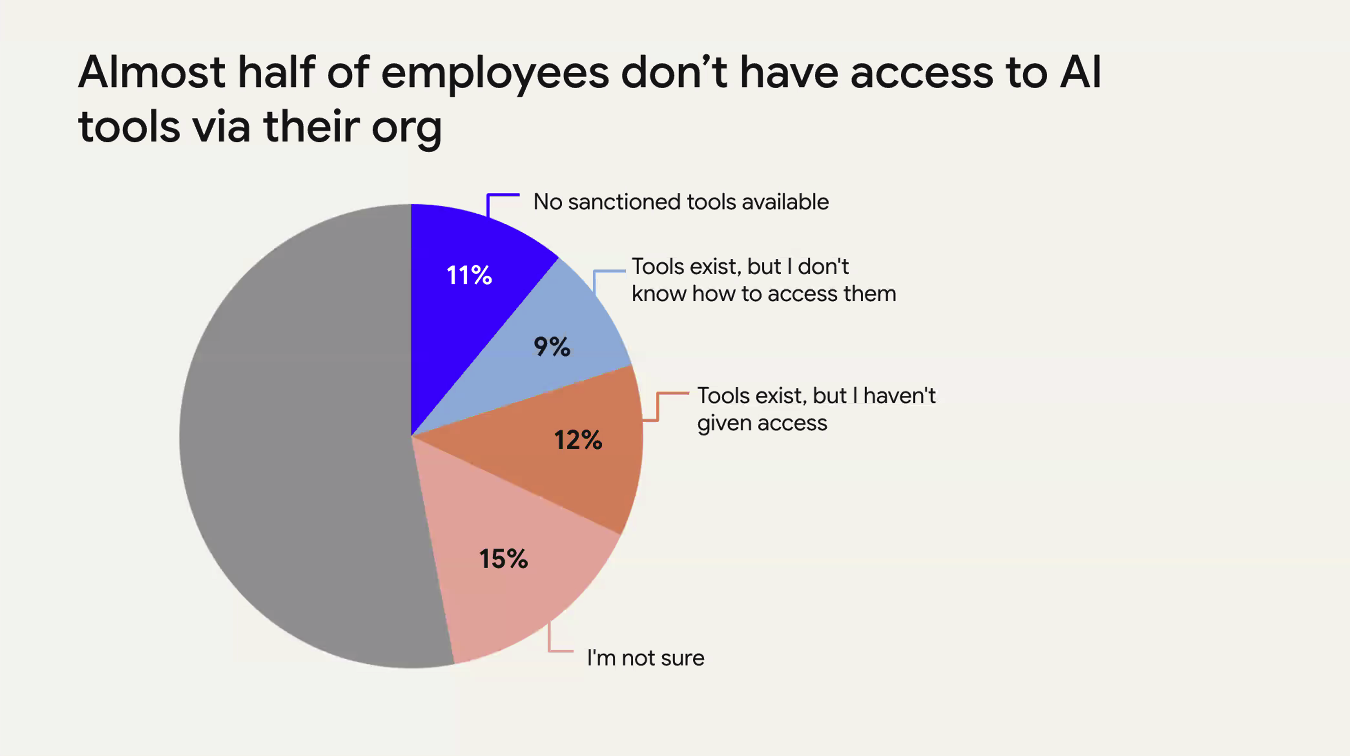
The survey found that 79% of managers have not demonstrated their own AI use to their team in the last month. Not once. 65% of executives report that their workforce is positive or enthusiastic about AI — but only 33% of individual contributors feel the same. Half of employees say their organization has no AI policy, or it's unclear. 54% say there's no head of AI they know of, and another 11% say that person exists but it's a part-time role.
For knowledge workers, the practical implication is blunt: you are largely building this skill on your own time, from your own initiative, without institutional support. Move faster than your organization is — the people who do will be visibly ahead when the accountability structures finally catch up. Our knowledge worker AI reset playbook covers how to do exactly that.
11. The quality-speed tradeoff is collapsing — and that changes what competition looks like
Greg Shove framed this as one of the defining structural shifts. For most of knowledge work history, quality and speed have been in tension — great work takes longer, fast work lowers the bar. "Super companies" are breaking that tradeoff. Section delivers proposals and RFP responses to clients in hours, not days, without quality loss.
Patrick Murta (VP of AI Solutions, Centene) described the same pattern from the inside. An IT project estimator that historically took weeks to produce — a working prototype was running in three days and is now in active use. A competitive intelligence tool for managed care analysts — previously done by an army of people manually reading competitor policies — was built in a week.
AI-enabled teams are faster and better simultaneously, removing the constraint that used to force a choice between the two. If your organization isn't building these capabilities, you're competing on terms that no longer exist.
12. Agentic tools are available to 40% of knowledge workers — but only 16% are using them
The survey found that about 40% of employees say their employer has given them access to agentic tools. Only 16% say they actually use one. And only a third of people with agentic access have been coached or trained on how to use them at all.
The survey also found that of all the highest-value use cases employees reported, only three mentioned automation or an agentic solution. The practitioners who close this gap first are the ones who'll be most visibly differentiated by the end of 2026. If you have access to an agentic tool and haven't built a single workflow with it, that's your next move.
Protect your career by mastering AI
Every conversation at this summit pointed to the same underlying skill: the ability to work with context and orchestration — building systems where you define the requirements, structure the context, and orchestrate agents to carry the work forward.
That's the capability separating the 5% who are proficient from the 73% still experimenting. It's the difference between a practitioner whose AI runs while they sleep and one who opens a new chat window every morning. And it's teachable. If you want to understand the broader stakes of what this transition means for income and career trajectory, we've covered the structural picture here.
We're building a course specifically for knowledge workers who want to develop this skill — how to structure context, how to design orchestrations, how to build the personal AI infrastructure that compounds over time. We'll be launching it soon and we're looking for early testers to help shape the curriculum.
How helpful was this article?
Share this article
COO & VP Research, PH1 Research · Co-host, Product Impact Podcast
Latest Episodes ›
All episodes

The Time-Suck Era of AI Is Ending. Design Decides What Comes Next.

Your Approvals Are Teaching AI to Skip You

Lenny's 2026 Tech Survey: AI Burnout Is Surging, Layoff Fear Is High

The UX Researcher's Guide to Claude, Claude Cowork, and Claude Code
WTF is an AI-native org anyways? Let's compare Airbnb & Meta's opposing plans.

Future of UX Research: Guide for How UX Researchers Can Protect Their Jobs & Careers
Product Impact Newsletter
AI product strategy delivered weekly. Free.