Lenny's 2026 Tech Survey: AI Burnout Is Surging, Layoff Fear Is High
Noam Segal and Lenny Rachitsky's second annual tech worker sentiment survey found burnout up 11 points in a year, tech workers telling newcomers not to follow them, and a workforce splitting in two.
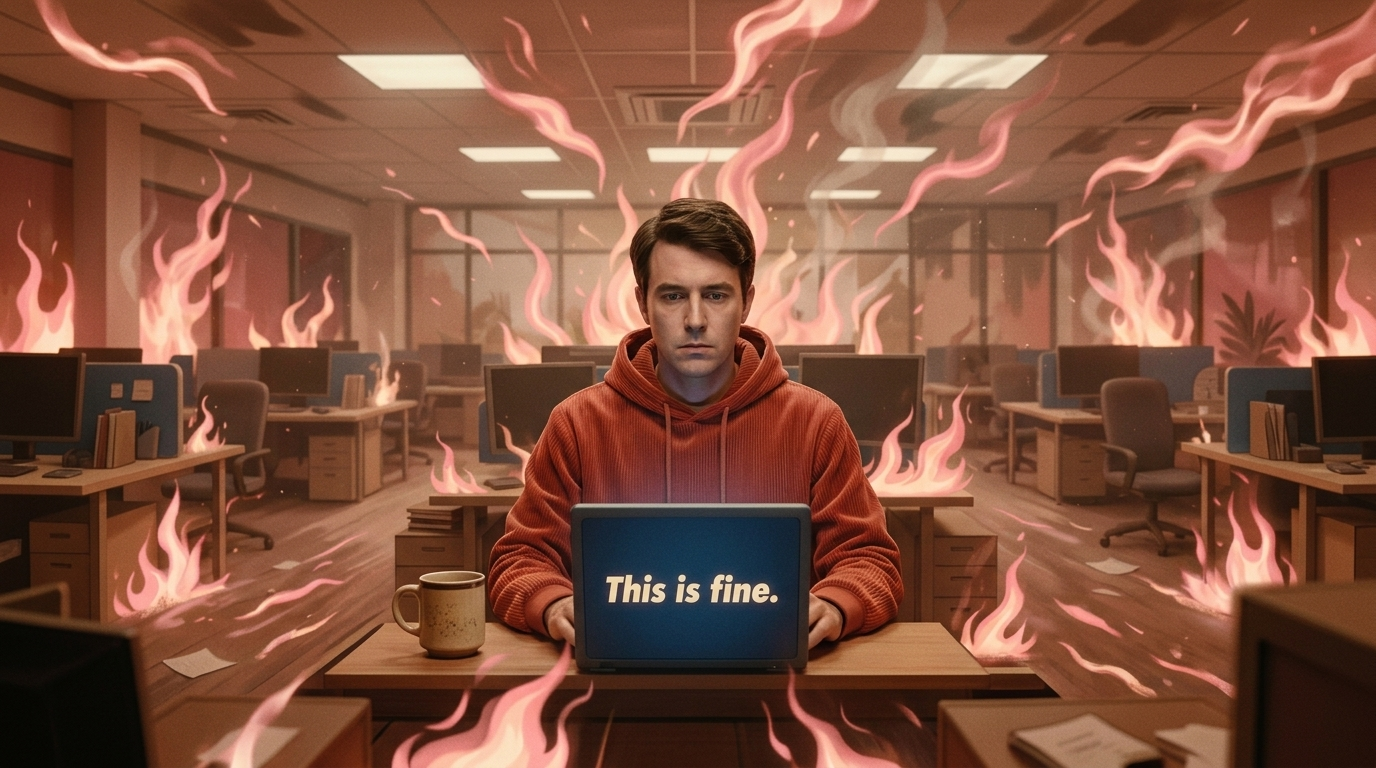
- ● Burnout among tech workers jumped from 44.7% to 55.7% in a single year, while career optimism fell from 54.8% to 48.7%, per Noam Segal and Lenny Rachitsky's second annual tech worker sentiment survey, published July 7, 2026.
- ● 41.2% of tech workers are at least moderately worried about layoffs, but the dominant fear isn't job loss — it's being expected to do more for the same pay (51%) at an unsustainable pace (46%).
- ● The workforce has split into four archetypes: the Energized (41%), the Conflicted (35%), the Disoriented (12%), and the Resentful (12%) — and AI identity stance predicts career optimism more strongly than role, seniority, or company size combined.
- ● More than half of tech workers (53%) would steer a newcomer away from their own field, even as 82% say AI is making them personally more productive — a reversal from a decade when tech topped Gallup's most-admired-industry rankings.
- ● Product Impact has been tracking this shake-up from every angle: the layoff template, the hidden labor tax of supervising AI, the ideology behind it, and now the emotional toll on the people living through it.
In 2026, enterprises still aren't converting AI investment into value at scale. Gartner reports that only 28% of AI initiatives in infrastructure and operations meet their ROI targets. Boston Consulting Group's 2026 AI at Scale survey of 1,800 executives found just 26% of companies have generated meaningful financial value from their AI spend. Writer's second annual adoption survey put the gap in the starkest terms yet: 97% of executives deployed AI agents in the past year, and only 29% report significant ROI — a 68-point deployment-to-value gap we covered in April. Two years into the enterprise AI spending boom, the dashboards still don't show the return.
Noam Segal and Lenny Rachitsky's second annual tech worker sentiment survey asks a different question. Instead of measuring enterprise ROI, it measures the roughly 6,000 people building, shipping, and living inside these AI deployments. What it finds is a fracture running through that workforce. Burnout jumped from 44.7% to 55.7% of respondents in a single year. Career optimism fell from 54.8% to 48.7%. And the single strongest predictor of how a tech worker feels about their career — stronger than role, seniority, or company size combined — is a simple identity question: has AI made you feel amplified, or has it made you feel like the ground is shifting under you.
The AI Era Is Disrupting How We Work & How We're Valued
Product Impact has been tracking this disruption from multiple angles since spring, and each piece adds a different layer to the same underlying shift: work is being restructured faster than anyone, executives included, can measure whether the restructuring is actually working.
- The org chart. Brian Armstrong's Coinbase memo became the template for how tech companies are flattening management, eliminating pure-management roles, and building "AI-native pods" down to teams of one.
- The compensation model. The 100x performer piece shows what that template does to pay: payroll concentrating upward toward a small class of "100x" operators while the headcount cuts that fund their bands land on everyone else.
- The hidden labor. Glean's Work AI Index found the average worker now spends 6.4 hours a week supervising, correcting, and re-prompting the AI tools that were supposed to save them time — a tax nobody budgeted for.
- The ideology underneath it. The governing worldview driving all of this treats acceleration and concentration as unconditional goods, with no working model of belonging, community, or what happens to the people it leaves behind.
Lenny's survey is the piece that connects all four: what happens to the humans standing inside an org chart being flattened, paid under a compensation model built to reward a few, doing labor nobody accounted for, guided by an ideology that never asked what they needed. So far, this reshaping of work is benefiting almost no one — not the workers absorbing it, and not yet the organizations attempting it, 97% of which have deployed AI agents while only 29% can show a return.
The Data: Burnout Up, Optimism Down, and the Fear Isn't Replacement
Significant burnout — moderate, very, or complete — is now the majority experience in tech. The headline numbers, year over year:
- Significant burnout: 44.7% (2025) → 55.7% (2026)
- Career optimism: 54.8% (2025) → 48.7% (2026)
- Job enjoyment: holding steady at 42.6% "very much" or "extremely"
- Layoff worry: 41.2% at least moderately worried, 19.9% "very" or "extremely" worried
- Top fears: expected to do more for the same pay (51%), an unsustainable pace (46%) — versus "losing my job to AI" (22%)
Enjoyment holding steady while burnout and optimism move in opposite directions isn't a contradiction: enjoyment is about the work itself, burnout is about pace, and optimism is about where the pace is heading. Layoff worry is the strongest single predictor of career pessimism in the whole survey. But believing AI is already doing parts of your job barely moves that fear at all. Noam Segal put it bluntly on the podcast with Lenny Rachitsky:
"The honeymoon period with AI is over. When people are asked, 'What are you afraid of?' losing my job to AI is actually second to last. What we saw rise up to the top is the expectation to do more for the same pay."
Here's the data point that matters most: nearly everyone feels more productive, and almost no one feels their work has actually gotten better.
- 82% say AI is making them at least moderately better at their job
- 49.4% say "very much" or "extremely" better
- Asked what "better" means in their own words, respondents described more output, not higher quality
Individual respondents said it more bluntly: "My brain is rotting. My work feels worse," one wrote. Another: "I feel like I don't think hard enough anymore — I just follow Claude. I don't fully understand what I merge."
Why Burnout, Falling Behind, and Being Left Out All Spike at Once
The data is telling a frightening story: even when AI is making you more productive, it doesn't feel like it's been good for your career or your mental health. Three compounding realities explain why.
The bar resets every quarter, so the exhaustion never gets to end. Segal put it plainly in his conversation with Rachitsky: "the speed AI unlocked got plowed straight back into expectations. Every gain becomes the new baseline, and the people expected to hit it are running out of room to breathe." That is the mechanism behind the jump from 44.7% to 55.7% significant burnout: the work itself hasn't gotten harder in absolute terms, but there is permanently more of it, because whatever a person shipped last quarter with AI's help is this quarter's floor. Nikhyl Singhal's term for the result, cited in the survey, is "smiling exhaustion" — shipping again, compensation climbing, and no off-switch.
Falling behind is now a six-month cycle, not a career-length one. Ethan Mollick's rule that "today's AI is the worst AI you will ever use" describes a capability curve, but for workers it describes a personal deadline: MIT Media Lab's EEG research found heavy AI users had measurably weaker neural connectivity and could not quote from essays they had just written, while Microsoft and CMU's survey of 319 knowledge workers linked higher AI confidence to less critical thinking. The fear isn't a robot taking your job in one event. It's watching the specific expertise you spent a decade building get absorbed by a tool released last quarter, while your own judgment quietly erodes from relying on it.
The ladder is disappearing from underneath, not just at the bottom. Segal compared the industry to Cognition's Devin climbing "from a high school CS student to a college intern to a junior engineer," and said tech workers are watching the technology climb that same ladder, pulling the rungs out from under them as it goes. That is why even senior respondents, the ones with the skills and security to stay personally optimistic, are the ones telling newcomers not to follow them: the ladder they climbed is disappearing for whoever comes after.
The Bifurcated Workforce — And the Trap Inside It
The simplest way to understand tech right now is by outcome, not by role, seniority, or company size. Ask a tech worker how AI has changed their sense of themselves as a professional, and the answer sorts into five groups — and that group predicts their optimism, their burnout, and whether they'd tell a friend to follow them into the field better than their job title does. Noam Segal put it plainly on the podcast: "It's a very interesting picture that really cuts the tech workforce in half."
- Amplified ("I can do more, and better"): 49.0%
- Redefined (no clear positive or negative charge): 27.4%
- Destabilized ("I'm less sure where I stand or what's really mine"): 13.9%
- Diminished: 5.0%
- Unchanged: 3.2%
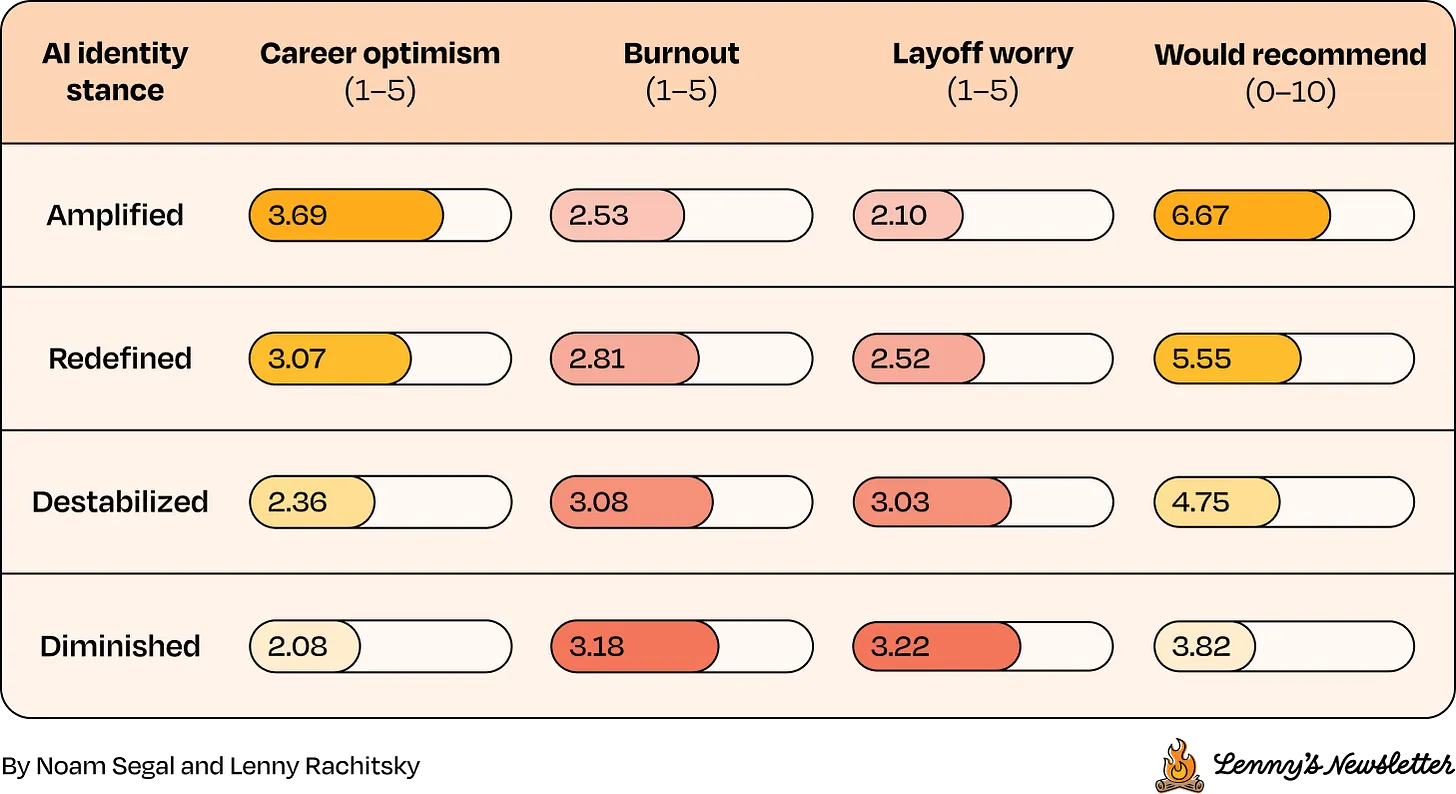
Here's what makes this worth taking seriously instead of filing away as one more survey stat: when researchers tested every variable in the dataset against every other, that identity question beat role, seniority, and company size combined as the single strongest predictor of how someone feels about their career. A UX researcher who feels amplified and a UX researcher who feels destabilized have less in common, career-outlook-wise, than a destabilized researcher has with a destabilized product manager or a destabilized designer. The split runs across roles, not within them.
- AI identity stance predicts career optimism and willingness to recommend the field more strongly than role, level, or company size combined
- The gap it produces is roughly three times the size of the well-documented "founder happiness effect" — the boost founders get just from running their own show, which shows up in both years of this survey
I am one of the amplified, and I want to name the trap inside that number, because "amplified" gets sold as an unambiguous win and it isn't one. Being amplified means the bar keeps moving: whatever you shipped last quarter with AI's help becomes this quarter's baseline expectation, and the tempo of learning never lets up. If you're a PM who suddenly ships PRDs, prototypes, and stakeholder decks in a day, the same PM is expected to do it in an hour six months from now, on top of everything else already on your plate. The 51% of respondents who named "expected to do more for the same compensation" as their top fear are drawn heavily from exactly this amplified group. That's the smiling exhaustion described above, and it's a cost the people experiencing it, myself included, are still learning to price correctly.
Tech Workers Are Telling Others This Is a Terrible Job
The survey asked an NPS-style question: on a scale of 0 to 10, how likely are you to recommend a career in your role to a friend starting out today? The result was an average score of –39. More than half of working tech professionals (53%) would actively steer a newcomer away from the path they chose, and a third of respondents who describe themselves as career optimists would still not recommend their own field.
Here's the number that should stop you: founders scored –5. Founders — the group in this same survey with the highest optimism, the lowest burnout, the least layoff worry, and the most excitement about AI of anyone measured — still land in negative territory when asked whether they'd recommend their own path. If the people with the most upside, the most control, and the most reason to be evangelists for this era won't tell a friend to follow them into it, nobody downstream of them is going to either. Designers and researchers, who report the least upside and the most anxiety of any role, scored the lowest in the survey.
"What you are seeing here is that no one is a promoter of their role in tech right now, not even founders who are by far the happiest, happy-go-lucky people in tech right now."
This isn't disgruntled juniors venting about a bad market — it's the people this technology has treated best, by the survey's own measures, declining to vouch for the industry that made them that way.
The –39 score reverses where tech stood in the public's estimation a decade ago. In Gallup's August 2015 industry ratings poll of 25 U.S. business sectors, the computer industry posted a 69% net-positive rating, a few points off its 73% peak three years earlier but still in a virtual tie with restaurants for the most positively viewed industry in the country, a position it had held or contended for since Gallup started tracking industry sentiment in 2001. Tech was the industry Americans admired most in 2015 — in 2026, it's the industry its own practitioners are telling the next generation to avoid.
Individual respondents are largely at peace with their own trajectory: they have the skills and seniority to ride out the transition. What they've lost faith in is the on-ramp for whoever comes next: "I'm lucky I'm later in my career… I won't be in a position to hire and mentor new PMs, but I'll be safe. Which feels really crappy to say."
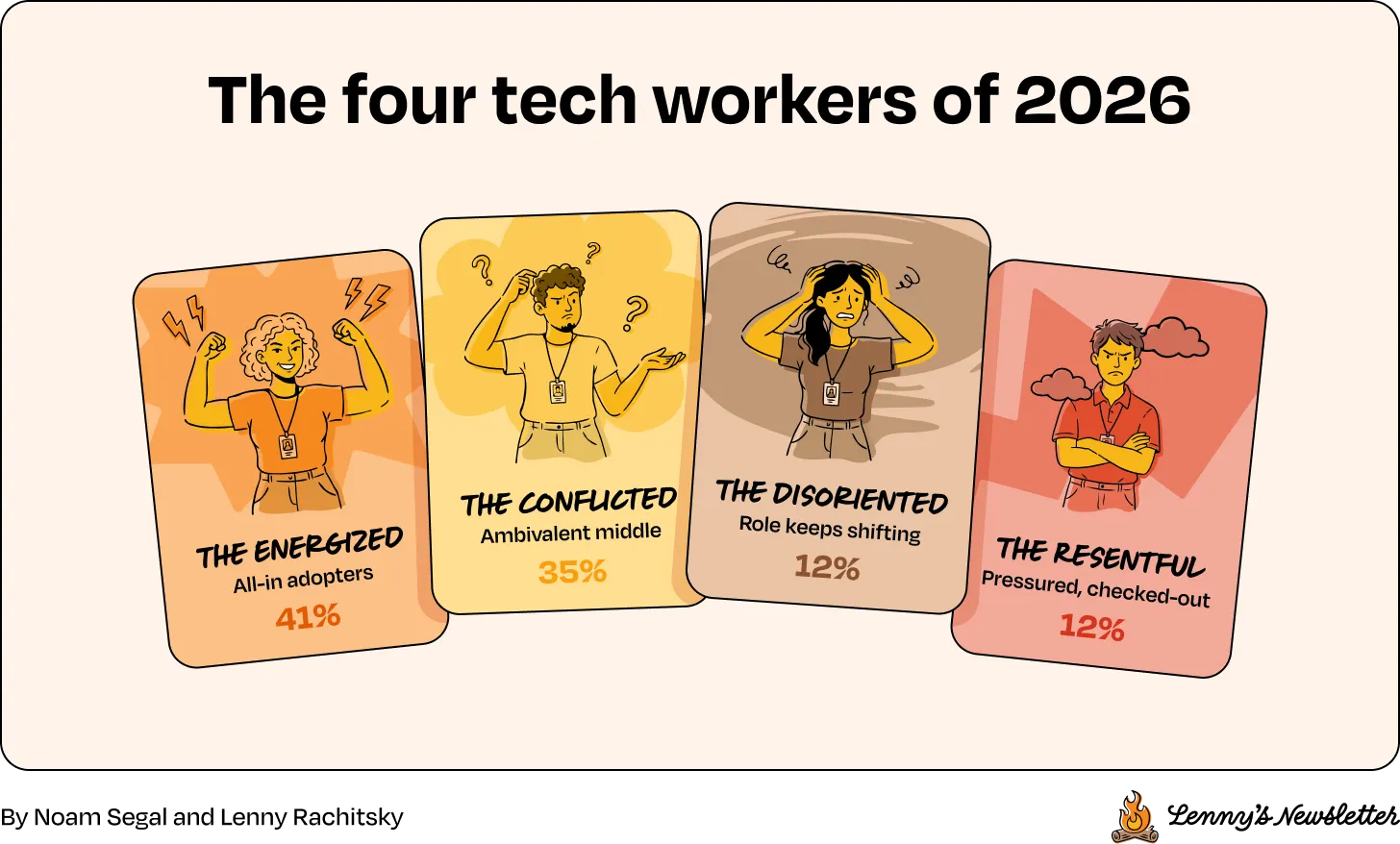
The Four Tech Workers of 2026 — And Four Paths Through It
The Energized (41%). Lead with excited (91%), curious (83%), and hopeful (59%). The most optimistic group, the least burned out, and the only segment with a clearly positive read on their field. "Product has become fun again," one principal-level IC said. "We're in an amusement park."
The Conflicted (35%). The largest group after the Energized, and the ambivalent center of gravity. Their top emotion is holding positive and negative feelings at once (68%), closely trailed by overwhelmed (56%) and tired (55%). "I'm simultaneously having the most fun I've had as a product builder and also feeling the most uncertainty I've felt," one senior PM said.
The Disoriented (12%). Defined by a role that keeps shifting beneath them, layered with overwhelmed (74%) and tired (73%). A VP of product compared the position to "farmers on the cusp of the industrial revolution" — confident the long-term direction is right, unable to see a clear path through the near term.
The Resentful (12%). Every respondent in this group selected "resentful — I feel pressured to use AI," clustered with tired, conflicted, and overwhelmed. The lowest optimism, the lowest willingness to recommend their field, and the lowest sense that AI is helping them at all. "Tech overall kind of sucks right now," one director of product said. "We used to adopt new technology because we were excited... Now all we hear is 'use AI or you will lose your job' — and then people get fired anyway."
Every function on a product team is struggling with some version of this, which is exactly why we published a full playbook for knowledge workers navigating AI-driven layoffs and career resets in May. Its four paths, read against what Lenny's respondents are actually describing:
- Navigate the reorg from inside. Viable when your organization is genuinely redesigning rather than just cutting, and when you can position yourself in the judgment layer before the restructuring assigns you elsewhere. Lenny's data gives the prerequisite a number: manager standing in the redesign process is the strongest single lever in the survey, producing 65% higher job enjoyment where managers are rated highly effective, yet only 25.5% of respondents have one. The Conflicted, who already hold real standing and a mixed-but-genuine track record, are best positioned to make this move — the task is naming the interface role you're already halfway into before someone else defines it for you.
- Move to a better-positioned organization. Viable when your specialty is healthy in the broader market but your current employer is restructuring in ways that don't need your function's durable core. This is the direct answer to what the survey's Disoriented group described above — confident in the long-term direction, unable to find a path through the near term inside their current org. Senior practitioners with current AI fluency and real domain depth are still scarce enough to command pricing power, a window that closes as the next cohort develops the same fluency natively.
- Pivot to an adjacent domain. Viable when your function is contracting market-wide, not just at your employer. Brookings found roughly 70% of highly AI-exposed workers have transferable skills for a role shift, but the pivot has to be scoped to durable capabilities, not job titles. This is the option for the functions Lenny's survey ranks lowest on both willingness to recommend and layoff fear: designers and researchers, whose specialty is under pressure industry-wide, not just inside any one company.
- Go independent. Viable when you have a real track record and network. MBO Partners found 5.6 million US independent professionals earning over $100K, up 19% year over year, and Upwork's 2026 research found AI-enabled freelancers earning roughly 40% more per hour than peers using traditional methods. This is the path for the Resentful, the group in Lenny's data reporting the lowest optimism and the lowest sense that AI is helping them at all. Waiting for that resentment to lift rarely works. Trading organizational pressure for ownership at least changes what you're managing.
We Need Mentorship & Communities of Practice More Than Ever
Every archetype above is either burnt out, falling behind, or getting pushed toward the door, mostly managing it alone. The strongest lever in the whole survey isn't a new tool. It's a person who's already been through this, willing to answer the question you're afraid to ask.
Tech doesn't need another AI feature — it needs people supporting each other through this reset. Tell us on LinkedIn — Arpy Dragffy and Brittany Hobbs — which conversation matters most to you, and we'll bring it to the show: Arpy on the product lens, Brittany on research and market.
For the full picture, read Noam Segal and Lenny Rachitsky's original survey report and listen to their conversation about it on Lenny's Podcast.
Sources
- Images sourced from Lenny's newsletter
- How tech workers are feeling in 2026: a workforce splitting in two — Noam Segal and Lenny Rachitsky
- How tech workers actually feel about AI in 2026 (podcast episode) — Lenny's Podcast
- Gartner: AI projects in infrastructure and operations stall ahead of ROI
- Writer's 2026 enterprise AI adoption survey
- Gallup: Internet Industry Nets Record Positive Rating (2015)
- Every CEO Will Post a Layoff Notice Like This — Product Impact
- The 100x Performer Is Real — Product Impact
- New Report Says You're Wasting More Time Botsitting Than Getting Value from AI — Product Impact
- Silicon Valley's AI Is Repeating the Social Media Mistake — Product Impact
- Playbook for Knowledge Workers to Survive the AI Jobpocalypse — Product Impact
How helpful was this article?
Share this article
Latest Episodes ›
All episodes

Your Approvals Are Teaching AI to Skip You

The 100x Performer Is Real. So Is the Market It Requires Everyone Else to Lose.

OpenAI & Anthropic are charging us way more than we need

The UX Researcher's Guide to Claude, Claude Cowork, and Claude Code
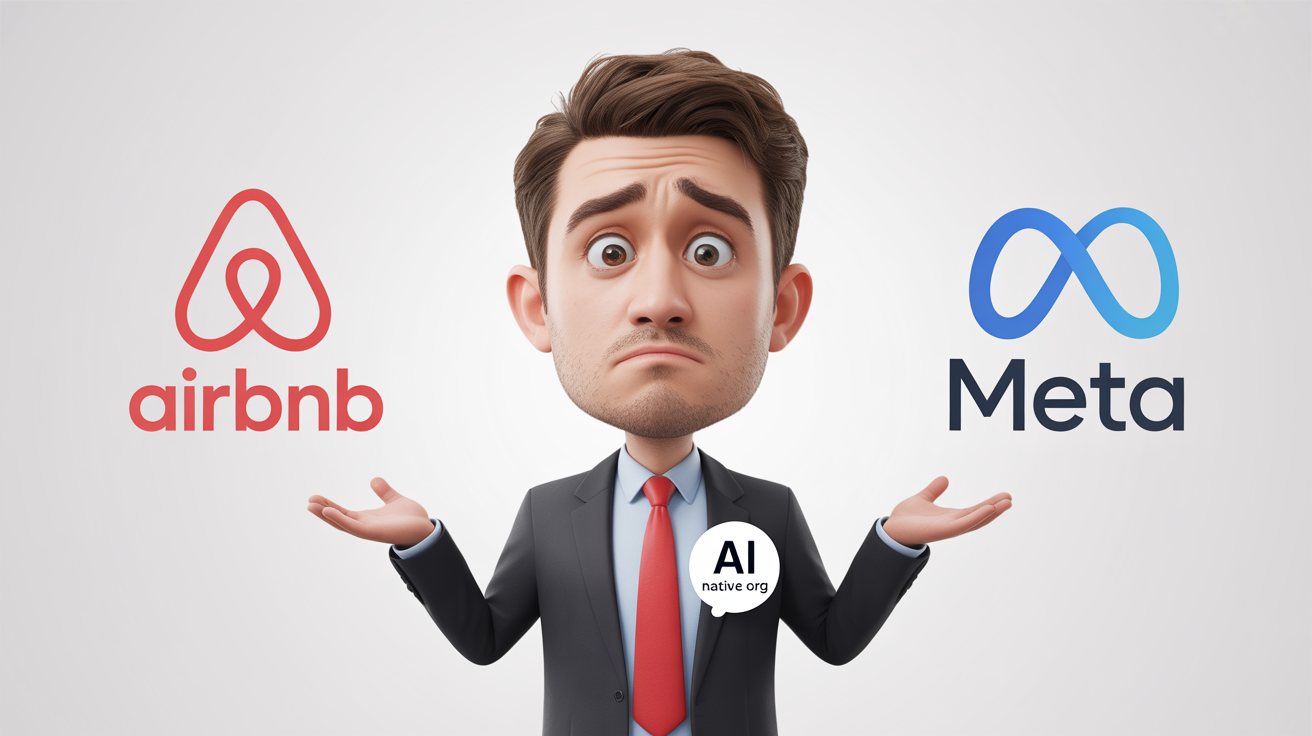
WTF is an AI-native org anyways? Let's compare Airbnb & Meta's opposing plans.

Future of UX Research: Guide for How UX Researchers Can Protect Their Jobs & Careers
Product Impact Newsletter
AI product strategy delivered weekly. Free.