Search is the use case that every business should be focused on solving with AI
AI didn't invent people's preference for search — it proved how badly businesses have neglected it. Fixing search is the highest-leverage AI bet most companies aren't making.
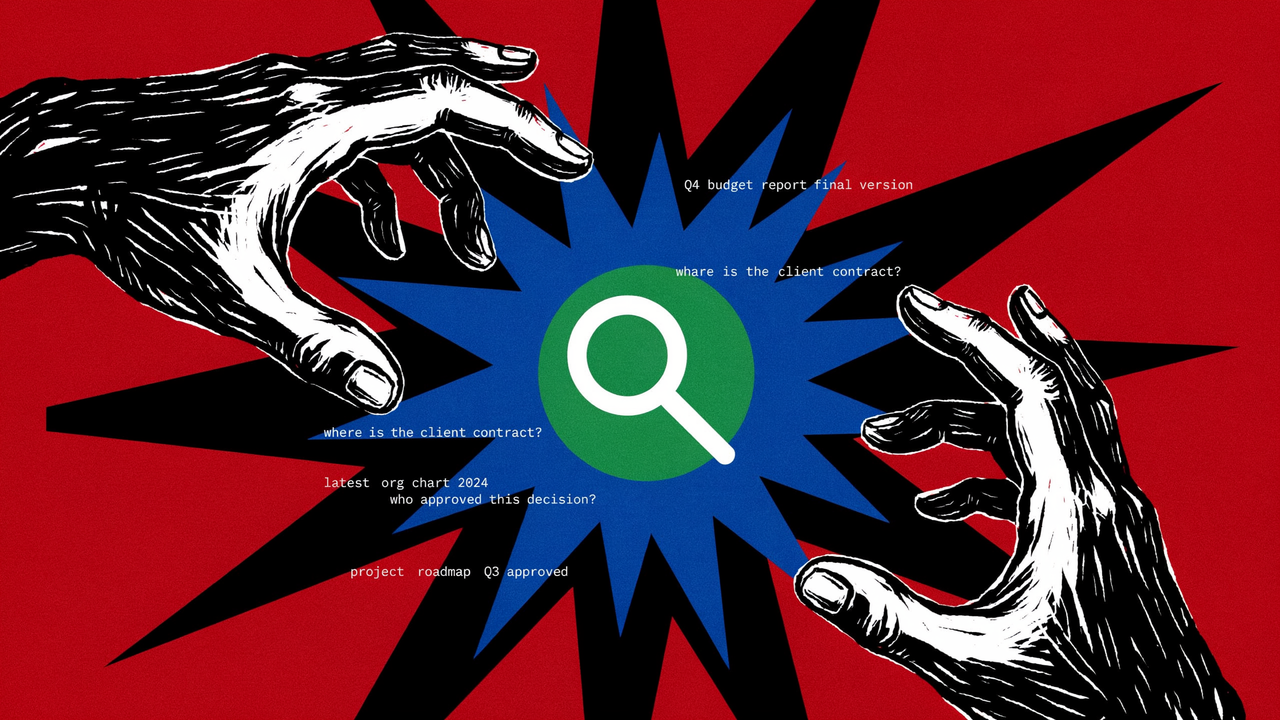
- ● Enterprise search succeeds on the first attempt only 10% of the time, versus roughly 95% for Google
- ● 73% of organizations have no real enterprise search tool, and knowledge workers lose nearly a full day a week hunting for information (McKinsey)
- ● 94% of consumers get irrelevant results from on-site search, costing US retailers $300B a year
- ● Glean went from $100M to $200M ARR in nine months, then to $300M ARR by May 2026
- ● Every RAG pipeline and AI agent is only as good as the search under it — retrieval, not the model, is the real bottleneck
The most valuable AI project at your company is the one almost nobody is staffing: fixing search. I don't mean the AI search war with Google that fills the headlines. I mean the search box on your own website and inside your own company — the one that returns nothing useful, pushes people back to Google, and quietly bleeds revenue and trust no dashboard traces back to it. I've spent almost two decades building digital products for Microsoft, Spotify, Mozilla, Hims & Hers, the National Football League, and several universities, and that box has been broken at every one, with no one funded to fix it.
The neglect is now the opportunity, and the numbers are stark. Enterprise search returns a useful answer on the first try only about 10% of the time, against roughly 95% for Google. Glean built a business from zero to $300 million in ARR in a few years doing little more than fixing this. And every copilot and agent you ship is only as good as the retrieval feeding it — the model is the commodity now, search is the foundation underneath it.
In my last piece, the data showed AI's two real consumer use cases are search and companionship, the same two things that built the internet. For a business, search isn't a footnote in that story — it's the whole strategy, the highest-leverage AI bet on the table, sitting in plain sight while everyone chases the flashier one.
Search is AI's proven use case — the data says so twice over
The evidence isn't subtle. 37% of consumers now start searches with an AI tool, and 60% read AI-generated summaries instead of clicking through — the two use cases, from the last piece, that people actually adopted ahead of everything the industry promised would be bigger.
The business side tells the identical story with harder numbers. Searchers are only 15% of ecommerce visitors but generate 45% of revenue, converting at roughly 2.5 times the rate of everyone else. The retailers know it: in Algolia's 2026 survey, search ranked as retail's single top digital priority, ahead of every other place they could put an AI budget. Whatever use case your roadmap is debating, your own customers are already proving with their wallets that search matters most.
Google's dominance isn't the threat you should be watching
The instinct is to watch Google's grip on query volume and conclude the AI search race is the only search problem worth a meeting. It's misdirected. The real bleeding is on your own website and inside your own company's data, where search has failed customers and employees for years with nobody senior noticing.
94% of consumers globally report getting irrelevant results when they search a retailer's own site, and nearly half simply buy the item from someone else after a failed search. Seventy-seven percent avoid websites where they've had a bad search experience, and that failure costs US retailers an estimated $300 billion a year. Inside the walls, it's worse: enterprise search tools succeed on a user's first attempt only about 10% of the time, against roughly 95% first-page accuracy from Google. Employees have learned not to trust the tools their own company built for them.
Two decades in, the lesson never changes: search has always been underfunded
The pattern repeated at every one of those companies. Budget pours into the homepage, the checkout flow, the onboarding sequence — the parts that show up in a deck. Search gets a line item and a part-time owner, treated as plumbing rather than the feature customers reach for the moment your information architecture fails them.
Across products used by hundreds of millions of people, that underinvestment has been the most consistent gap I've seen — a structural pattern, not a rounding error. The person who built the most valuable answer to it agrees: Arvind Jain, who spent a decade scaling Google Search before founding Glean, calls enterprise search a neglected problem, not a hard one. The technology to fix it existed. The will to fund it didn't.
Even flawless UX can't stop people from defaulting to search
This isn't a hunch from my own testing — it's one of the most durable findings in usability research. Nielsen Norman Group finds the split lopsided: more than half of all users are "search-dominant," heading straight for the search box, while only about a fifth are "link-dominant" browsers. Baymard Institute's ecommerce testing puts it even higher, with roughly 69% of shoppers going directly to site search. No matter how good your information architecture or interface, most users skip navigation and reach for the search box. It's how people behave when they want an answer faster than they want to browse.
The failure shows up when that box lets them down. When on-site search doesn't deliver, people don't blame the search bar — they conclude your website can't be trusted, open a new tab, and let Google route them to the exact page you already had. Seventy-seven percent of US consumers view a brand differently after an unsuccessful search, and nearly as many say they're less loyal to it. That's marketing spend pushing people through a front door that teaches them not to trust you — a cost that never lands on anyone's dashboard, because it was never their line item.
The problems search is supposed to solve are the ones that matter most
Here's where it gets deeper than information architecture. UX only makes the paths to a known destination easier. Search is what's left for everything else — and "everything else" is where the highest-stakes moments in the relationship live:
- The technical issue nobody wrote a landing page for.
- The billing change that's unique to one account.
- The data request that doesn't fit a menu or a nav item.
- Learning the product — figuring out what it can actually do for them and whether it's worth keeping.
These aren't edge cases — they decide whether someone stays or leaves, and search is the only tool built to catch them. It's also what people want to do on their own: 67% of customers prefer self-service to talking to a representative, and self-service is only as good as the search under it. Break that and you push your cheapest-to-serve customers into your most expensive support channel, or out the door.
I saw this most clearly on Mozilla's support center. Its visitors ranged from evangelists who'd defend the brand unprompted to people comparing offers and ready to leave. A search failure wasn't a minor inconvenience for either — it eroded the loyalists' trust and gave the switchers their reason to go. And nobody could see it happening, because it never showed up as a single dramatic failure. It was a slow leak in brand equity that never got its own line on a dashboard.
Small businesses are too busy firefighting to see the bleed
Small and midsize businesses rarely get to this problem, and not because they care less. Search failure doesn't look like an emergency. It looks like nothing — a slightly lower conversion number, a higher support queue, a customer who quietly left. But the scale of that "nothing" is enormous: 76% of US consumers say an unsuccessful search directly cost a retailer a sale. A founder juggling payroll, inventory, and a hundred fires a week won't notice that search is why a fifth of visitors leave without buying, because nobody on a ten-person team owns "diagnose the search bar" as a job. A broken search bar never wins the budget argument, and the bleed compounds for years before it's named.
Enterprises have the telemetry — and still no owner for the problem
Large companies don't have the SMB excuse. Customer-facing, they have analytics showing exactly where searches fail, where users abandon, where tickets spike because self-service didn't work. Internally, the scale of the loss is staggering and almost entirely unmeasured. McKinsey found knowledge workers spend the equivalent of nearly a full day every week just searching for and gathering information, and 73% of organizations still don't have a real enterprise search tool to cut it down. The data isn't the gap — the gap is organizational. These failures sit in the seams between teams: search touches product, support, IT, and marketing at once, so it belongs to all of them and therefore none of them. Everyone sees the problem, but nobody's bonus depends on fixing it, so it survives quarter after quarter with no advocate.
Glean's rise from $0 to $200M ARR is the evidence
For proof, look at what happened the moment someone built a credible answer. Glean doubled from $100M to $200M in ARR in nine months — a jump Fortune confirmed independently — then hit $300M by May 2026. The company has raised roughly $768 million and was valued at $7.2 billion in its most recent round. None of that is an accident. Enterprise buyers finally had a tool for a problem they'd quietly bled from for a decade, and they wrote checks the moment it existed.
AI agents are a double-edged sword
AI makes the fundamental fix more achievable than ever — it can stitch together disparate systems, reconcile inconsistent formats, and surface the right answer from a mess no human team was going to clean up by hand. That's the useful half of the sword.
The other half is where most executives point their budget: the much-hyped promise of autonomous agents running whole workflows unsupervised, while the search underneath them stays broken. Every RAG pipeline, copilot, and agent you ship is a search system with a language model bolted on top, and the model can only reason over what retrieval hands it. An agent built on bad search inherits every failure, now with more confidence and less visibility into where it went wrong. Fund the flashier bet before the foundation and you automate that 10% first-attempt failure rate at machine speed.
You don't have to take my word for it. Marc Benioff makes the same point about his largest competitor, calling Microsoft's Copilot "a flop" because Microsoft "lacks the data, metadata, and enterprise security models to create real corporate intelligence" — which, in his telling, is why it returns inaccurate answers and leaks corporate data. Discount the rivalry, and the diagnosis is still the one this piece is making: the agent didn't fail on the model, it failed on the foundation underneath it.
The people building AI's frontier agree: search is the whole stack
The strongest case for prioritizing search isn't mine — it's the quiet consensus among the people building AI's frontier: the model is becoming a commodity, and the retrieval layer feeding it is where the value lives. Andrej Karpathy, who coined the term the field now uses, calls context engineering "the delicate art and science of filling the context window with just the right information for the next step." Strip the jargon and that is a description of search: getting the right information in front of the model at the right moment. A brilliant model handed the wrong document is worthless — the right one makes a mediocre model look like magic.
Nobody has bet harder on this than Jain, that same ex-Google-Search engineer. His whole Glean thesis is that context is the prerequisite for everything in enterprise AI: the model is generic and knows nothing about your company until something connects it to how your business actually runs. TechCrunch called what he's building "the layer beneath the interface". That layer is search, and every agent, copilot, and assistant your company deploys will either stand on it or fall through it.
Fixing search forces the diagnosis every business has been avoiding
Search deserves priority for a reason beyond the leaked revenue and eroded trust. Fixing it forces you to diagnose why it broke, and that diagnosis is the one most companies have avoided for years: disparate databases that were never meant to talk, no real data governance, and the fingerprints of successive leaders who each built their own system and never agreed with the last. It's the same rot that stalls everything else — MIT found 95% of enterprise generative-AI pilots never make it past the experimental phase, and the model is rarely the reason. The fragmented data it's pointed at is.
AI is the first real answer to that mess — not a smarter search box, but a system that can reason across the fragmentation instead of waiting for a decade-long cleanup that never comes.
Unlock the new business operating system
Solve search and you stop a leak — but you also unlock something most companies have never had: knowledge and decisions interoperable across the entire enterprise. Once every system, document, and conversation is reachable through one layer that understands your business, the walls between tools stop mattering. A question doesn't care whether its answer lives in Salesforce, Slack, a contract PDF, or a half-finished Jira ticket, and neither does the agent asking it.
That interoperable layer is the precondition for everything the industry is now racing toward. Satya Nadella has said the era of standalone apps is fading, replaced by agents that sit on top of shared data rather than inside siloed tools. Foundation Capital calls the same shift "systems of agents" that collapse the enterprise stack. The new interoperability standards — Anthropic's Model Context Protocol, Google's Agent-to-Agent protocol — exist for exactly this reason: to let agents operate across systems instead of trapped inside one. Every one of those futures rests on the same foundation: search. Glean is the live proof — what began as enterprise search is now the platform its customers build and run agents on.
Get this right and agents stop being clever features stuck in one team's sandbox. They become a workforce operating across the whole stack — a support agent that can see billing, an analyst agent that pulls finance and CRM data in the same breath. That is the business operating system every vendor is promising you, and it runs on search. Without search, it doesn't exist.
Where to start
Before you fund another agent, instrument the search you already have. Pull the numbers almost nobody looks at — your site's zero-result rate, the share of sessions that search and then exit, the gap between search-users' conversion and everyone else's, the internal queries your employees give up on. Then give the problem a single accountable owner instead of leaving it in the seam between four teams. That diagnosis is unglamorous, mostly a data and governance problem wearing a UX costume, and it's the highest-leverage AI work most companies could do this year.
Contact me to discuss the roadmap for your business. Search will be the key to unlocking the business value of AI and addresses the gaps that will undermine your website as answer engines steal more of your traffic.
How helpful was this article?
Share this article
Latest Episodes ›
All episodes

Google and LLMs Are Destroying Your Website & Traffic

The Definitive Guide to Wearables: How Watches & Rings Disrupt AI Product Strategy
The Time-Suck Era of AI Is Ending. Design Decides What Comes Next.

The UX Researcher's Guide to Claude, Claude Cowork, and Claude Code

WTF is an AI-native org anyways? Let's compare Airbnb & Meta's opposing plans.

Future of UX Research: Guide for How UX Researchers Can Protect Their Jobs & Careers
Product Impact Newsletter
AI product strategy delivered weekly. Free.